
Read the Swedish version here.
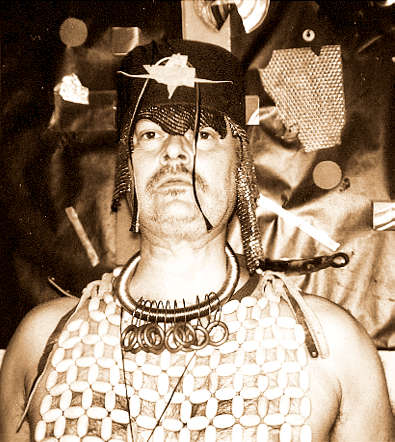
What is avantgarde? I ask myself while sitting with avant-garde sculptor, musician, poet and theatre man Yuriy Zmorovych in his chaotic but very cozy studio in central Kyiv. Books, sculptures, self-made instruments, videotapes, DVDs and vinyl records are stacked in a very wayward regime only known by Yuriy. How should I manage to explain the greatness, humor and the presence of this man’s work, by just using some few words? I ask myself further. For many the term avant-garde have elitistic, pretentious and even obsolete conjections. But Yuriy Zmorovychs avantgarde do not fit into this description. His avantgarde expression is playful, intelligence which feels current and contemporary, without being pretentious. It must be the humor that is key to, I think, for Yuriy has no problem laughing captivating when he talks about his own creations and ideas.
In the 1990s he started to work with international artists and one of the more memorable was when he worked with the French group improvisation ARFI. (ARFI stands for Association à la recherche d’un Folklore imaginaire.) In a few weeks in August 1991 they played on a river boat that went from Kiev to Odessa. Between their improvisations, they all sat like glued in front of the radio and listened to the reports on events from Moscow. It was the time when the Soviet Union fell apart.
In constant opposition
For Yuriy, this was symbolic. He went on his river boat and broke new ground, or traveling in new waters, with avantgarde musicians who had similar views on the creation of his own. And in then same time Soviet Union came to an end. For him, avantgarde must constantly stands in opposition to the norm, fighting oppression and those who exercise power.
It was never easy to be improvisational in the Soviet Union, he says, adding that it is of course much easier for young people today to choose that path. Jazz was, for example, prohibited, and he tells emphatically how he, after several years of searching, found “A Drum Is a Woman” by Duke Ellington on a black market in Odessa.
– Duke Ellington had a great spontaneity and it has always been fruitful for my own creativity. But since I came into improvised jazz and avant-garde, I must admit that I abandoned him to others. Along with the Dadaism and Malevich, Ellington are my icons, Yuriy implies.
Yuriy would not want to notify other sources of inspiration, and responds that it could be anything. The rain, a cat jamar, no talking, cars driving along the street, or an internal flow.
The key to the avantgarde expression, according to Yuriy to listen to the spontaneous creative process, to dare to open the doors to the inner voice and not be afraid of what you hear, and the second cornerstone of the avantgarde expression is that always stand in opposition against the norm. This expression is found in the inner voice if you just listen, he says.
His untuned piano was a great beginning
Already in the beginning, in 1970s, his drive was to create a kind of noise generator or stream from the innermost of the soul and the body. He says that he therefor began to play on an untuned piano. An excellent choice, Yuriy implies.
– In my ears it sounded accurate, of course, he laughs.
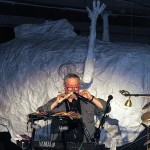
– Like this, he says and picks up an old plastic bottle with a round hole in the middle. Through the plastic bottle, he has strained a guitar string. When he plays on the string, while screws on the cap, it sounds actually strangely surreal.
Avantgarde theater
In the 1990s Yuriy had the opportunity to become the creative leader for avantgarde theater Teatr AA. His partner was Olexandr Nesterov (link in Ukrainian), a legendary avantgarde guitarist and composer who dead in 2005. They worked with both amateur and professional actors. Important for the project was to lead the actors to learn to play instruments, and to act spontaneously, to improvise. This was not always easy, since many were trained actors. To release an already learned knowledge of how acting should be is not easy, says Yuriy.
In Memoriam Nesterov – with Kiritchenko, Коtrа, Zagaykevych, Letov, Makarov, Borisov, Yaremchuk, Tovstukha, Khmelyov, Ohrymchuk, Strelnikov, Klymenko, Zmorovych, Smetanin, Rudyi, Putyatin, Khmelyov, Makhno. NOTE! You hear Zmorovych in the second piece (if ou have any problem hearing it here, go to the website, see the link above) and not on the first, that is Yuriy Yaremchuck performing!
Teatr AAA got much attention, not only in former Soviet Union but also in Western Europe and the USA. But during the crisis years of the 1990s the sponsors fled and the theater had to be closed.
“Avantgarde should never be decorative”
Yuriy loves to to work with amateurs. He argues that the most important thing is to be creative and to be self-taught and that does not necessarily mean that you do not know how to create. He argues that many musicians or artists in avantgarde often are overly decorative in their design and not in opposition to the norm. He points a little at his compatriot Yuriy Jaremchych, he also worked with previously. But they have chosen different ways and is therefore not entirely agree on the avantgarde expression. At the same time Yuriy Zmorovych would never allow condemnation against other artists.
I ask him what he thinks about the future and he urge that he believes that a new generations will bring avantgarde further to new dimensions. The forms will of course be different, but the most incentives will stand.
– The human mind is collective, and our knowledge is shared. New influences will of course be added as our lives are changing. These are doors that the avantgardist should open. But how it will be can only the future reveal, he concludes.
And I am really feel enthusiastic by his optimism.
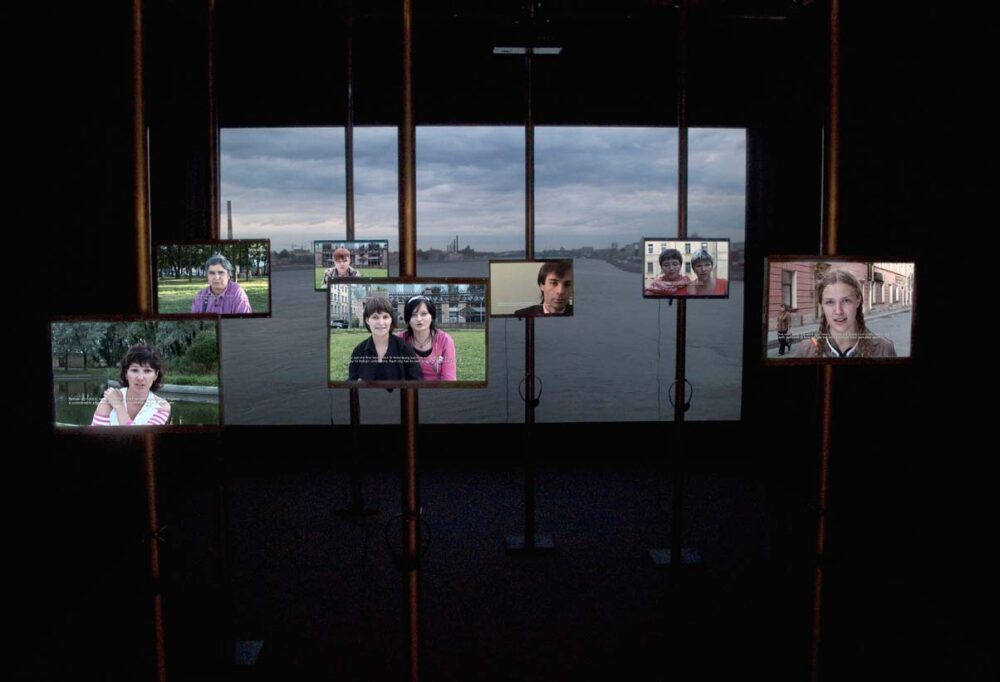
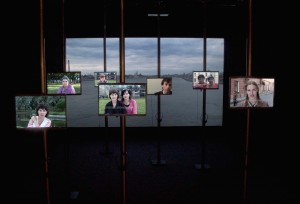 State of Mind consolidates to a trilogy together with Resonance and Code of Silence. In different ways these lens-based art installations cast light on aspects of socially and culturally constructed identity-based groups in contemporary society. Photography and video are used in combination to expand on the separate histories of the two media with regard to interviews and portraits in documentary genres. This is the point of departure for all three installations. As for the overall narrative, the topics of how and why different groupings construct networks and communities in order to achieve a sense of belonging are in focus, as well as the conditions and necessities for forming the community. The projects look at the social conventions family, love and career, dealing with power relations such as gender, ethnicity, sexual orientation and class. The method of collecting the material in fieldwork is similar in the three projects, but the questions asked and issues raised are specific to each segment of the installations. Portraiture and personally based stories are central. The trilogy is presented as three separate art installations, which co-exist and cross-inform each other. They reflect upon civil rights issues and the idea of being safe and productive within society, working in the space between personal choice and social expectations. Memory, narration, visual representation and oral history are central. In each of the three works a different group is approached that relates to the artists’ personal lives. Resonance [Resonance was exhibited at Norrköping Art Museum, Göteborgs Konsthall and Uppsala Museum of Art during 2006-2007.], our first collaboration, is based on a network of peers belonging to a successful generation of artists and curators. They are all women who made an entrance onto the Swedish and Danish art scene in the 1990´s, and now have international careers. On one level Resonance is an examination of the Scandinavian welfare state, and in more specific terms, the impact of the conditions it creates for the portrayed women to make it on the art scene. In Code of Silence [Code of Silence will be ready to be launched in 2009.] this is a sibling group of five who grew up on a small farm in rural Gothenburg, Sweden. The farm had to face the challenge of major cultural reforms in the nineteenth century, but remained intact. It became a target for expropriation during the 1950´s and 70´s to make way for the reforms involved in building the modern Sweden. Hence, it remained an object of possible interest for the national cultural heritage. The farm was finally demolished in 2004. Code of Silence is based on oral history, memories told by the siblings infringing the UN’s Declaration of Human Rights paragraph 17 relating to everyone’s right to a home. In addition this installation includes a large number of private and official documents such as hand-written wills, receipts from selling milk, and letters to the King of Sweden. State of Mind explores everyday life and the boundaries between ethics, legislation, prejudice and civic expectations in the LGBTQ [Lesbian, Gay, Bisexual, Transsexual, Queer] life of St. Petersburg, Russia. It emphasizes individuals identifying as lesbians or bisexual women.