[Part II of Olga Karach's adventures in the local election in Belarus]
‘Off with her head!’ the Red Queen shouted at the top of her voice. Nobody moved. ‘Who cares for you?’ said Alice, (she had grown to her full size by this time.) ‘You’re nothing but a pack of cards!’ At this the whole pack rose up into the air, and came flying down upon her.
Two cards from two different packs… Sorry, two members from two different commissions called me on Tuesday and informed me that they cancelled my registration for the coming elections to the City Council. The pretext they found was the distributing of green balloons to children. The balloons were given out outside my election precincts, and naturally they did not carry my name or any other names. Apparently, the commissions were running out of time (the elections are due in five days), so they were ready to declare a violation any action of mine. If not balloons, I could have been banned from the elections for a green scarf.

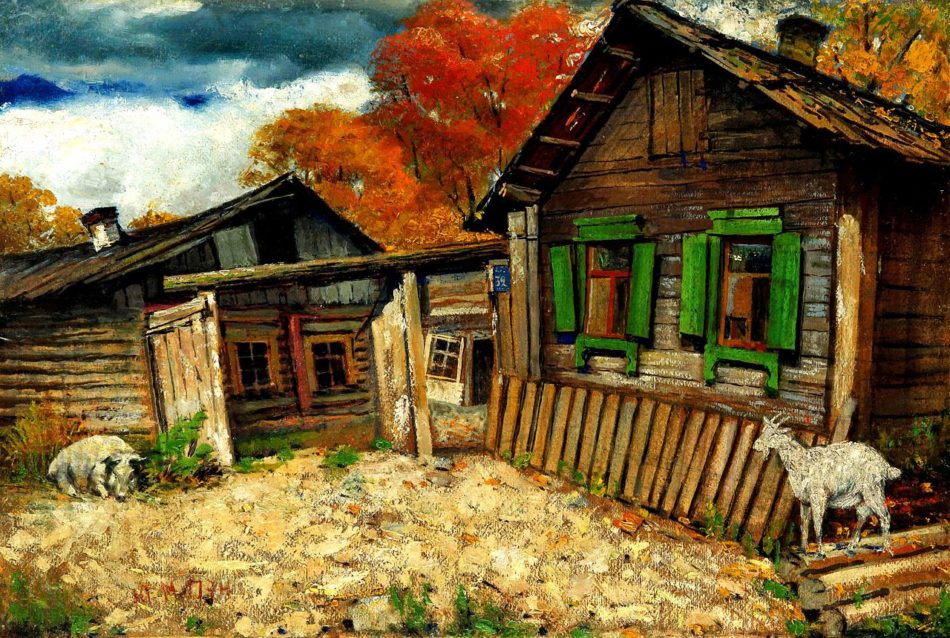
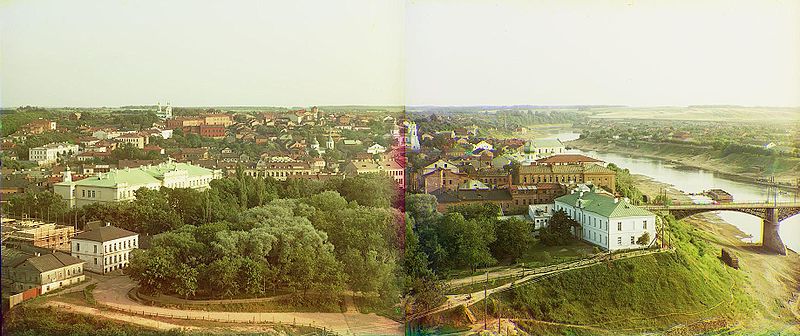
Vitebsk from 1912. From wiki commons.
The three persons who signed the petitions urging to punish me are not from my precincts. I also strongly doubt that they wrote the petitions themselves, not just signed the ready-made text. One of them is the Chief Manager of Municipality Branch #9 in Vitebsk.The second is a woman named Tatiana Tadeushevna Andreieva living at 68-4 Pravdy Street. As for the third person, we know only the last name (Starikovich) and partially the residence address (76 Moskovski Prospekt). However, in the court we will surely learn the full information about the signers and will publish it.
So now authorities consider me not eligible for the elections. But how much ‘elective’ the elections have become, how much of fair elections is left in this staged cricket game? The pro-governmental candidate, Mr. Bashmetov, has shamelessly been making use of his administrative position. Being the Rector of a government-controlled university, he used its premises for meetings and its faculty for organizing the meetings. The students were forced to go to the meetings, sometimes instead of classes. For high-school graduates Mr. Bashmetov was promising almost free admission to the university, if only he becomes one of the ‘deputies’. To crown it all, with the term exams coming many female students were ‘strongly advised’ to take part in concerts and cheer actions for Mr. Bashmetov’s promotion.
The government-staffed commissions reviewed his slanderous complaints against me practically immediately. At the same time only one out of my six complaints of April 14-20 was reviewed. The resolution signed by Mr. Miadelets, the Chair, read ‘a number of solutions have been found which now satisfy all the parties involved’. Besides the fact that no real solution was found, the resolution definitely implied that I am not a party involved. Needless to mention, the other five complaints of mine have never been reviewed.
‘That’s not a regular rule’, Alice remarked, ‘you invented it just now.’
‘It’s the oldest rule in the book!’ cried the Red Queen.
‘Then it ought to be Number One,’ said Alice.
The Red Queen turned pale, and shut her note-book hastily.
Why the officials are changing even their own rules so hastily? What are they scared of? I have no doubts the reason was the number of my representatives. Suddenly the packs (sorry again, the Commissions) got it right that our team will do everything necessary to properly monitor the counting of votes. Their hopes to reach their own goal set from the top were suddenly jeopardized. Fair elections would definitely mean failures of pro-government candidates.
I am addressing to all citizens who were going to support me: show your attitude to this staged game which officials call ‘elections’. You can do it in two ways:
1. You can just ignore the game. Do not come to the election precinct. Why waste time, if the result is fixed and forged anyway? To give officials an opportunity to give their decisions a label of ‘working people’s will’? To let them reduce social security, to raise taxes and utilities, to do nothing about real needs, and call it ‘fulfilling the working people’s orders’?
2. You can come to the election precinct and cross out all the names, then write ‘For Karach’, and put your ballot into the ballot-box. This way you will show the Red Queen and her packs that you are not a pawn in their games, where rules are being changed at will (maybe even as a result of a schizophrenic reaction). You will show that you are a human, and you demand the right to choice. Both ways are good, though they differ in openness, of course.
Continue reading ‘My Quest of the City Council: Playing the rule-changing game’


State of Mind consolidates to a trilogy together with Resonance and Code of Silence. In different ways these lens-based art installations cast light on aspects of socially and culturally constructed identity-based groups in contemporary society. Photography and video are used in combination to expand on the separate histories of the two media with regard to interviews and portraits in documentary genres. This is the point of departure for all three installations. As for the overall narrative, the topics of how and why different groupings construct networks and communities in order to achieve a sense of belonging are in focus, as well as the conditions and necessities for forming the community. The projects look at the social conventions family, love and career, dealing with power relations such as gender, ethnicity, sexual orientation and class. The method of collecting the material in fieldwork is similar in the three projects, but the questions asked and issues raised are specific to each segment of the installations. Portraiture and personally based stories are central. The trilogy is presented as three separate art installations, which co-exist and cross-inform each other. They reflect upon civil rights issues and the idea of being safe and productive within society, working in the space between personal choice and social expectations. Memory, narration, visual representation and oral history are central. In each of the three works a different group is approached that relates to the artists’ personal lives. Resonance [Resonance was exhibited at Norrköping Art Museum, Göteborgs Konsthall and Uppsala Museum of Art during 2006-2007.], our first collaboration, is based on a network of peers belonging to a successful generation of artists and curators. They are all women who made an entrance onto the Swedish and Danish art scene in the 1990´s, and now have international careers. On one level Resonance is an examination of the Scandinavian welfare state, and in more specific terms, the impact of the conditions it creates for the portrayed women to make it on the art scene. In Code of Silence [Code of Silence will be ready to be launched in 2009.] this is a sibling group of five who grew up on a small farm in rural Gothenburg, Sweden. The farm had to face the challenge of major cultural reforms in the nineteenth century, but remained intact. It became a target for expropriation during the 1950´s and 70´s to make way for the reforms involved in building the modern Sweden. Hence, it remained an object of possible interest for the national cultural heritage. The farm was finally demolished in 2004. Code of Silence is based on oral history, memories told by the siblings infringing the UN’s Declaration of Human Rights paragraph 17 relating to everyone’s right to a home. In addition this installation includes a large number of private and official documents such as hand-written wills, receipts from selling milk, and letters to the King of Sweden. State of Mind explores everyday life and the boundaries between ethics, legislation, prejudice and civic expectations in the LGBTQ [Lesbian, Gay, Bisexual, Transsexual, Queer] life of St. Petersburg, Russia. It emphasizes individuals identifying as lesbians or bisexual women.