Jazz bez inleddes redan i går, men själv kunde jag inte gå förrän idag. Det var dock ingen dålig start på mitt Jazz bez. Jag fick glädjen att återse, eller snarare återhöra, en favorit från Köpenhamns jazzfestival 2013. Igor Osypovs kvartett. Denne gitarrist, bördig från Donetsk, är en fascinerade improvisationsexpert. Lägg där till påhittiga kompositioner, och du får en härlig sammansmältning. En extra eloge ska gå till altsaxofonisten Logan Richardson. Hans varma, men också vågade spelstil, lyfter Osypovs kompositioner.
Första setet var också lysande. Trombonisten Bartosz Pernal från Polen, har sammanställt ett intressant gäng. Kajetan Galas på hammondorgel var helt enkelt fenomenal. Att få höra någon bemästra detta svåra instrument är alltid en njutning. Själv är jag dessutom mycket svag för tromboner, och det är härligt när någon verkligen kan, och vågar, tänja denna trilskande metallsnabel.
Min första dag på Jazz Bez var med andra ord idel lyckoträffar. Jag längtar redan till morgondagens jazzövningar.
Bokmässan i Lviv avslutades för egen del på Dzyga, med ett internationellt och instrumentellt möte, mellan två giganter och två, möjligen tre, uppstickare. Den svenske bassisten Joel Grip som spelar tillsammans med den franske saxofonisten Pierre Borel (tillsammans kallar de sig borelgrip) mötte Yuri Yaremchuk och Mark Tokar i något som kan liknas vid en tandemspelning. Kvällen inleddes med filmen Valerik 0.9s (se nedan) en film gjord av en hemlös pojke i Odessa. Filmen, som sammanställts av Joel Grip, kom till under projektet “Homeless Voices Heard in Ukraine” som finansierades av Drottning Silvias barnfond.
Därefter tog giganterna Yaremchuk och Tokar vid. Duon är enormt rutinerad och trots att de spelar inom den svåråtkomliga genren avantgarde är deras samspel, deras unika dialog, helt möjlig att följa och känna med.
Att komma efter dessa giganter är troligen inte lätt. Men borelgrip klarade den uppgiften. De är mindre rutinerade, hälften så gamla, med färre erfarenheter, som givetvis avtecknar sig i deras spel. Men de är även kanske ivrigare, och därför mer utmanande. Det var även här fint att följa deras spel, som dessutom lovar om en mycket intressant framtid.
Kvällen avslutades med att de fyra spelade tillsammans. Det var en fantastisk upplevelse att höra hur de fyra lyssnade på varandra och hur de föll in i en intressant dialog. En dialog som i alla fall jag önskat varat längre. När det fyrspelta mötet löd mot sitt slut bröt musikern, producenten, poeten (?) Sergei Kleyn in med en megafonljudande störningar som ljöd lika mycket muntert som provokativt. En avslutning som gav en särskild extra udd till en mycket fin spelning.
Book Forum i Lviv är sannerligen kaotiskt och trångt, men enligt min mening mycket mysigare och mer inbjudande än Göteborgs bokmässa. Book Forum känns mer som en plats som handlar om just böcker – i Göteborg känns det ofta som en plastig branschmässa, vilken som helst. En av de mest välbesökta montrarna var förlaget Piramida och bland titlarna återfanns Anna-Lena Laurens “De är inte kloka, de där ryssarna” som nyligen översatts till ukrainska av Natalia Ivanchuch.
Ute på gården var det härligt folkliv.
Inomhus var det dock lite stökigare,
men ändå en gemytlig atmosfär.
Ursprungligt tryck.
Men efter någon timme i folkhavet var det ändå härligt att kunna smita iväg till Kupol och av en händelse mötas av Juriy Jaremchucks underbara saxofonspel. Det var sannerligen en inspirerande avslutning på en trevlig eftermiddag.
På söndag, den 18 september, får Lviv svenskt besök i den experimentella musikens tecken. Den svenska basisten Joel Grip kommer att spela tillsammans med den franske saxofonisten Pierre Borel. De framträder förstås på Dzyga och tiden är satt till 19.00.
På deras hemsida finns det möjlighet att se dem på film samt få ett smakprov på deras ekvilibristika utsvävningar.
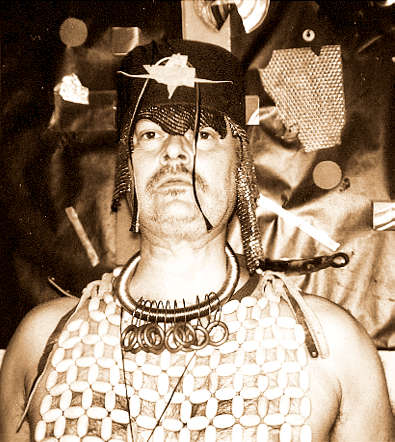
What is avantgarde? I ask myself while sitting with avant-garde sculptor, musician, poet and theatre man Yuriy Zmorovych in his chaotic but very cozy studio in central Kyiv. Books, sculptures, self-made instruments, videotapes, DVDs and vinyl records are stacked in a very wayward regime only known by Yuriy. How should I manage to explain the greatness, humor and the presence of this man’s work, by just using some few words? I ask myself further. For many the term avant-garde have elitistic, pretentious and even obsolete conjections. But Yuriy Zmorovychs avantgarde do not fit into this description. His avantgarde expression is playful, intelligence which feels current and contemporary, without being pretentious. It must be the humor that is key to, I think, for Yuriy has no problem laughing captivating when he talks about his own creations and ideas.
ЮРИЙ ЗМОРОВИЧ / YURIY ZMOROVYCHYuriy Zmorovych has a great production. He began his career as an improviser in early 1970s. And in the early 1980s, he met the Russian musician and avantgardist Sergei Letov. This meeting has led to several collaborations, but in the beginning it was actually mainly film-making and Yuriy made two films together with Letov, improvised on the theme of creation.
In the 1990s he started to work with international artists and one of the more memorable was when he worked with the French group improvisation ARFI. (ARFI stands for Association à la recherche d’un Folklore imaginaire.) In a few weeks in August 1991 they played on a river boat that went from Kiev to Odessa. Between their improvisations, they all sat like glued in front of the radio and listened to the reports on events from Moscow. It was the time when the Soviet Union fell apart.
In constant opposition
For Yuriy, this was symbolic. He went on his river boat and broke new ground, or traveling in new waters, with avantgarde musicians who had similar views on the creation of his own. And in then same time Soviet Union came to an end. For him, avantgarde must constantly stands in opposition to the norm, fighting oppression and those who exercise power.
It was never easy to be improvisational in the Soviet Union, he says, adding that it is of course much easier for young people today to choose that path. Jazz was, for example, prohibited, and he tells emphatically how he, after several years of searching, found “A Drum Is a Woman” by Duke Ellington on a black market in Odessa.
– Duke Ellington had a great spontaneity and it has always been fruitful for my own creativity. But since I came into improvised jazz and avant-garde, I must admit that I abandoned him to others. Along with the Dadaism and Malevich, Ellington are my icons, Yuriy implies.
Yuriy would not want to notify other sources of inspiration, and responds that it could be anything. The rain, a cat jamar, no talking, cars driving along the street, or an internal flow.
The key to the avantgarde expression, according to Yuriy to listen to the spontaneous creative process, to dare to open the doors to the inner voice and not be afraid of what you hear, and the second cornerstone of the avantgarde expression is that always stand in opposition against the norm. This expression is found in the inner voice if you just listen, he says.
His untuned piano was a great beginning
Already in the beginning, in 1970s, his drive was to create a kind of noise generator or stream from the innermost of the soul and the body. He says that he therefor began to play on an untuned piano. An excellent choice, Yuriy implies.
– In my ears it sounded accurate, of course, he laughs.
YURIY ZMOROVYCHBy then he started to build his own instruments. The material was everything he found around him. Metal, plastic, cloth, paper, combined with a guitar string can make miracles.
– Like this, he says and picks up an old plastic bottle with a round hole in the middle. Through the plastic bottle, he has strained a guitar string. When he plays on the string, while screws on the cap, it sounds actually strangely surreal.
Avantgarde theater
In the 1990s Yuriy had the opportunity to become the creative leader for avantgarde theater Teatr AA. His partner was Olexandr Nesterov (link in Ukrainian), a legendary avantgarde guitarist and composer who dead in 2005. They worked with both amateur and professional actors. Important for the project was to lead the actors to learn to play instruments, and to act spontaneously, to improvise. This was not always easy, since many were trained actors. To release an already learned knowledge of how acting should be is not easy, says Yuriy.
In Memoriam Nesterov – with Kiritchenko, Коtrа, Zagaykevych, Letov, Makarov, Borisov, Yaremchuk, Tovstukha, Khmelyov, Ohrymchuk, Strelnikov, Klymenko, Zmorovych, Smetanin, Rudyi, Putyatin, Khmelyov, Makhno. NOTE! You hear Zmorovych in the second piece (if ou have any problem hearing it here, go to the website, see the link above) and not on the first, that is Yuriy Yaremchuck performing!
Teatr AAA got much attention, not only in former Soviet Union but also in Western Europe and the USA. But during the crisis years of the 1990s the sponsors fled and the theater had to be closed.
“Avantgarde should never be decorative”
Yuriy loves to to work with amateurs. He argues that the most important thing is to be creative and to be self-taught and that does not necessarily mean that you do not know how to create. He argues that many musicians or artists in avantgarde often are overly decorative in their design and not in opposition to the norm. He points a little at his compatriot Yuriy Jaremchych, he also worked with previously. But they have chosen different ways and is therefore not entirely agree on the avantgarde expression. At the same time Yuriy Zmorovych would never allow condemnation against other artists.
I ask him what he thinks about the future and he urge that he believes that a new generations will bring avantgarde further to new dimensions. The forms will of course be different, but the most incentives will stand.
– The human mind is collective, and our knowledge is shared. New influences will of course be added as our lives are changing. These are doors that the avantgardist should open. But how it will be can only the future reveal, he concludes.
And I am really feel enthusiastic by his optimism.
This website uses cookies to improve your experience. We'll assume you're ok with this, but you can opt-out if you wish.AcceptRejectRead More
Privacy & Cookies Policy
Privacy Overview
This website uses cookies to improve your experience while you navigate through the website. Out of these, the cookies that are categorized as necessary are stored on your browser as they are essential for the working of basic functionalities of the website. We also use third-party cookies that help us analyze and understand how you use this website. These cookies will be stored in your browser only with your consent. You also have the option to opt-out of these cookies. But opting out of some of these cookies may affect your browsing experience.
Necessary cookies are absolutely essential for the website to function properly. This category only includes cookies that ensures basic functionalities and security features of the website. These cookies do not store any personal information.
Any cookies that may not be particularly necessary for the website to function and is used specifically to collect user personal data via analytics, ads, other embedded contents are termed as non-necessary cookies. It is mandatory to procure user consent prior to running these cookies on your website.