– Tanken med “Moscow International Open Book Festival” är att visa besökarna att böcker inte bara har reducerats till kommers. Vi vill istället sätta fokus på litteraturen och författarnas tankar om kreativitet och skapande. Vår avsikten är alltså inte att sälja böcker i mängder, det sker på vanliga bokmässor, utan att fokusera på literaturen och författarna, säger Nick.
Nick Okhotin på Proekt_Fabrika under Museernas natt i Moskva 15 maj 2010.
Ungefär 80% av det som försiggår på “Moscow International Open Book Festival” handlar om litteratur, men för att överleva och locka till sig besökare har man bjudit in andra aktörer. Förra året bjöd de till exempel in den amerikanska anarkisten och filosofen John Zerzan. Det var en verkligt populär programpunkt. Andra populära inslag på festivalen, som inte hade en direkt koppling till litteratur, var en diskussionsduell mellan olika kulturföreträdare. De hade till exempel en duell mellan en filmkritiker och en filmskapare.
Nicks ambition med festivalen är att försöka göra festivalen något mer eklektisk än den varit tidigare, så att bidrag som beskrivits ovan blir mer vanliga. Han ser det som en viktig vitamininjektion för att inspirera det kulturella debattklimatet och likaså bokmarknaden, som han för övrigt anser den vara i stort behov av nya impulser.
Men att vara yrkesverksam på den ryska bokmarknaden är allt annat än riskfritt. För ungefär två år sedan mördades till exempel en förläggare för ett förlag som ger ut skolböcker och det är just där som korruptionen är som störst, menar Nick. Han försätter med att påpeka att hela bokmarknaden är en enda röra. Det verkar som om det finns en avsaknad av mål och visioner, säger han och menar att det finns många exempel på dåliga projekt i bokbranschen.
– “Piramida” är ett sådant exempel. Det var en bokaffärskedja här i Moskva som fanns på många platser. Butikerna låg ofta på exklusiva adresser. Deras hyror måste varit skyhöga. Proekt OGI Bookstore var en av många som engagerade sig och satsade i Piramida. Men problemet var att det inte fanns någon egentlig tanke eller idé bakom affärsidén, så de gick helt enkelt givetvis omkull. Vi förlorade runt 10.000 € vilket är ett enormt belopp för vår verksamhet. Det var nära att vi inte skulle klara det.
Nick hoppas därför på framtiden, men han ser inte särdeles ljust på den.
– Boken som form har svårt att konkurrera mot nya informationsvägar och läsplattan kan ju antingen vara en välsignelse eller det sista dråpslaget mot bokmarknaden. Förutsättningen är ju att folk fortsätter att läsa, men ibland är jag orolig att attityden till litteratur håller på att förändras, menar Nick. Och med den ryska litteraturens stolta tradition i åtanke kan jag inte låta bli att förfäras när en besökare på Fabika instämmer och berättar att det knappt finns något som helst intresse för inhemsk (eller internationell) litteratur bland yngre.
– De spelar dataspel eller surfar och verkar inte ha något intresse alls för att läsa, och Nick är enig med besökare.
Problemet med svikande intresse för litteratur är visserligen ett hyfsat globalt problem. Men för ett land som Ryssland, som ofta hänvisar till sin litterära dignitärer, får det kanske vidare konsekvenser. För hur går det med den ryska själen om den inte har någon kontakt med Dostojevskij eller Pusjkin?
Today, on May 26 2010, the Foundation Center for Contemporary Art in Kyiv invites readers and authors to KORYDOR – online magazine in Ukrainian, dedicated to contemporary art and contemporary culture.
KORYDOR.in.ua seeks to create archive of critical phenomena and events on contemporary culture. It is an open platform for discussions and lectures. KORYDOR has a goal to develop a professional and responsible criticism. The magazine will also work for a joint discussion with European partners. through international discussions, reviews, translations of critical texts. English versions will be launched in autumn 2010.
For more information write to art[at]cca[dot]kiev[dot]ua
Where is Western Ukraine in the new political order? You could be forgiven for thinking it had disappeared from the map altogether. The new President has put a Russian in charge of the country, and set out on a course coherent with restoring Ukraine’s place to that of the ‘little Russia’ which had for the past 19 years existed only the minds of out-of-touch, chauvinistic Muscovites. Western Ukraine is now a marginalised and, some would argue, despised frontier province with nothing to offer the new order. It may even now, some might suppose, become the ‘enemy’ on which the need for ‘stability’ (meaning authoritarianism) is sold to the people, in the way that Russia scapegoats the clearly terrifying Estonia and Georgia (and up until now Ukraine) as reasons to stick to ‘strong government’. Egg-throwing and rostrum-blocking in parliament does little to dispel these insinuations.
If the new order is to persist, it poses questions to the west of the country that have never before been so prescient. Independent Ukraine was born of what one might call an unholy alliance between the communists of the east and the nationalists of the west. For many years this grand bargain carried benefits as well as disadvantages for both sides. Whilst an eastern-based business mafia held sway over the country’s industry and economy, a kind of ‘cultural mafia’ advanced a linguistic and cultural agenda that more favoured the west of the country. This grand bargain is now breaking up. Some would say this breaking up was started in the Yushchenko era. Others might contend that it is now, under Yanukovych, that one side of the country feels most disenfranchised. What is clear is that nothing is now being done with the aim of enhancing national unity. Instead of an over-arching, inclusive, reform-minded government under a prime minister such as Tigipko which the most optimistic might have hoped for, the new President has opted for a Russo-centric position. It is difficult to see how divisive appointments such as Tabachnyk can be considered necessary pragmatism. The idea that in the country that suffered the Holodomor children might in the very near future be opening textbooks that state that Stalin was a ‘strong leader who made tough decisions for Russia’ is going to be most sickening to those in the west.
Part of Western Ukraine’s problem is that the figures they have backed in the past have in fact served the region’s wider interests very poorly. Although large numbers turned out in the presidential second round to support Tymoshenko, there seemed little to recommend her, apart from that she wasn’t Yanukovych. The orange politicians who wrap themselves in Ukrainian patriotism in fact have interests much closer to the centre. At the other extreme, Ukrainian nationalist or patriotic parties can be seen as somewhat eccentric, perhaps extremist, in any case for many people not truly electable. Western Ukraine is clearly different to the rest of the country, culturally and linguistically and in its aspirations. These differences are only being exacerbated in the current circumstances. Western Ukrainians themselves need to start thinking about how to empower themselves against the current unenviable odds. A lot will depend on what sort of system emerges over the next couple of years.
If the current semi-parliamentary system persists, the west might look at its options modelled on regional/cultural political blocks in other European countries. In Italy, the Northern League sheds any illusions that it is a party of national consensus, and seeks to represent its regional interest within the country, where it feels under-represented. In Romania and Slovakia, the Hungarian minority is represented by Hungarian coalition parties. These coalition parties host within them a diverse set of views, from moderates to nationalists, but who manage to agree on over-arching concerns, and lobby for concessions in these areas, frequently as kingmakers in coalitions. Strong patriots might feel a need to prioritise issues such as UPA recognition, but in reality, forsaking the bigger issues over such matters does little to help the next generation. Even the People’s Self Defence block, which is an attempt at coalition party building, does not have a broad enough appeal. As the Conservatives in the UK who are learning coalition politics from scratch now realise, one has to look at the big picture. The over-arching issues for Western Ukrainians are obvious: education and language, relations with Europe and the need for a credible economic development policy for the region. So a kind of ‘Western Coalition’ could be the answer.
However, we face the real prospect that the 2012 parliamentary elections may mean very little. Even if they are free and fair, including access of all political groupings to the media, the acquisition of ‘tushki’ might allow the powers that be to ‘tidy up’ any slightly messy outcome to the vote. Or who is to say at the moment that these elections won’t go the way of the currently delayed local elections? If this election finishes with the west of the country having no voice, thoughts will inevitably turn to the idea of secession. A strategy for independence would then need some serious thought. If there is a clear sentiment in favour of the idea, unofficial polls might be conducted, perhaps modelled on the unofficial pro-independence referendums that have been taking place across Catalonia.
Independence would have many advantages. Patriotic Western Ukraine would have the over-arching unity of purpose that has benefited the likes of Hungary and Poland. The overseas diaspora would be able to assist in the kinds of ways they were in Estonia, for example. Also, with suggestions that Moldova might just sneak into the EU because ‘it’s small’ (a lame criteria perhaps, but it is how many in Brussels seem to think) perhaps the EU will be able to stomach a bite-size Ukraine of, say, 7-10 million people rather than 46 million, a good chunk of whom it can be argued don’t even want to be there. A small ship is easier to turn. Observe how previously backsliding Slovakia leapfrogged its neighbours to join the Euro.
This may all of course be pie in the sky. Secession is difficult to achieve from any country. However, if aggravations produce policy concessions rather than independence, this may in itself be valuable enough, and would be preferable to marginalisation. Against this however there is the question of the west-looking centre of Ukraine. They might be the next to be marginalised.
Perhaps a separatist approach is not the best way forward at a time when a united opposition is most crucial, but nonetheless Western Ukraine needs to think very carefully before persisting with politicians who talk the talk, but in fact have little interest in the region. There is a grave danger of Western Ukrainians continuing to throw away their votes to minigarchs, thugs and tushki, and it is perhaps time that, as a united front, the region acts for itself. In any case, if the coming years prove to be difficult, a distinction may develop between those who understand and defend their civil and democratic rights, and those who are prepared to allow their freedoms to be compromised for the ‘greater good’.
Of course, the best scenario is not independence for Western Ukraine but for the entire country to be anchored into the EU accession process which helps to foster civil rights, democracy and economic reform for the country as a whole, and which would put pay to many of the worries that currently exist. It is only in the complete absence of a membership perspective for Ukraine that worries about where Ukraine is drifting have become all too real, and hence the need to possibly take a look at some radical alternative scenarios. The alternative of wait and see could be very costly.
To take the analogy of Belgium, another European country that is frequently described as divided, a few decades ago the French-speaking south dominated industrially and culturally, whilst the Dutch-speaking north was poorer. A few years on it is now the north that is in the ascendency with its new industries, with the once proud south a decaying rustbelt. Steel and coalmining are yesterday’s industries, light manufacturing, services and tourism are tomorrow’s, and it is Western Ukraine that is best placed to grasp this opportunity, if it is allowed to.
Ukraine is now living a very particular situation. End of one historical circle (period of European dream born with Orange Revolution) and beginning of some entirely new and perhaps shadow time, marked by political decision of a new government to abandonee European and Euro Atlantic choice for Ukraine.
In that situation, Ukrainian young generation feel that they must do something (anything at all), to make his own position about situation living by contemporary Ukraine.
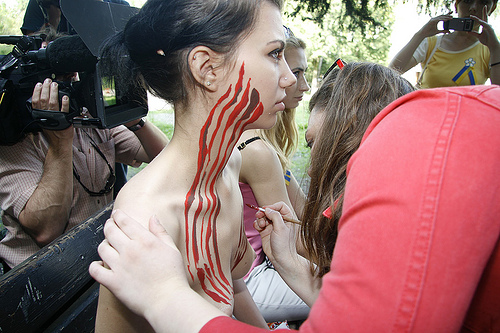
In this actual environment, every political, social or cultural organization or part of civic society uses its own “weapons” of choice. Ukrainian feminist organization FEMEN, received the recent visit of Medvedev with his own performance called “Scratched by bear”.
Other group of youngsters from Kyiv, start at May 11, 2010, a civic campaign “Make Ukraine better!”, intended to unite young generation of Ukrainians around of Ukrainian national idea, in way to remind all those who gave their lives for the country.
The bilingual manifesto of campaign (in Ukrainian and Russian) said:
In remembrance of those who fought for Ukraine and to together future – our initiative:
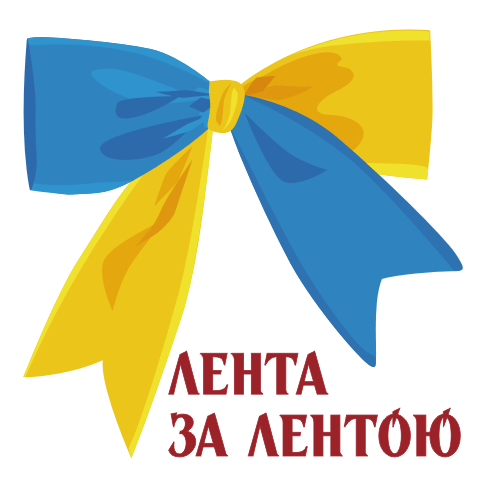
Belt for Belt (from famous UPA lyricsLenta Za Lentoyu”):
We have different political views. We speak different languages. But Ukraine is unique for us. Do not be afraid to say that. Do not be ashamed. Do not forget.
Put the flag on your apartment. Add the ribbon to your clothes – to the day-to-day one and to festive one and to any one.
You want to make life better in Ukraine? Do it. Anything. And think about more.
Do you want to do more than just putting the ribbon to your clothes? You’re not alone : )
There are all sorts of issues needing to resolution, and actions that can and should be done. For example, today’s issues to be solved by civil society:
1) demand for joint vision of history – as the basis for understanding in the society;
2) actions for organization of civil society;
3) action against state corruption and the filth of personal responsibility of state representatives and politicians (yes, they also must live with respect for the law and must behave decently);
3) support to culture (not for kitsch);
4) support poor and disadvantaged parcels of society;
5) etc, etc, etc …
You can propose your own actions; you also can support actions of others. For more information, visit the online community Make Ukraine better! There discussions are made, there activities are organized. Why not?
You also can help to our action as follows:
1) Place one of the proposed banners on your blog / site: lentaua.org.ua
2) Send to us your beautiful photos with the ribbons, organize a section of photographs, involve famous people, finally, our action allows your personal PR : )
3) Create the design of the original ribbons, banners or other promotional materials.
4) To popularize and disseminate our initiative in the press, in the Internet, in blogosphere, etc …
5) Share with us your ideas. Write to us, don’t be ashamed in@lentaua.org.ua or join the community http://community.livejournal.com/lenta_ua or visit the campaign website lentaua.org.ua
I vimlet på “Black market” på Proekt_Fabrika, sprang jag på Elena Tupyseva. Elena är en av Tsekhs drivkrafter. Tsekh är oberoende dansgrupp som är har sina lokaler i Proekt_Fabrika. Hon driver även Fabrikas konsertsal samt dess trevliga bar . Elena beskriver verksamheten i huset, och snabbt får jag klart för mig att detta är kanske en av de mer intressanta platserna i Moskva just nu, om man intresserar sig för vad som sker på den alternativa scenen. Proekt_Fabrika huserar flera olika aktiviteter, men alla som finns där är kopplat till den alternativa kulturscenen. Ja, förutom självaste fabriken, vill säga.
– Vet du om att fabriken fortfarande fungerar? De tillverkar papper och har upplåtit en del av deras yta till oss.
Elena vill helst inte spekulera i varför, men tror att det kan vara ett försök av företagsledningen att skapa goodwill.
-Eller så har de bara ett genuint intresse för kultur, vad vet jag? säger hon och skrattar.
Interiör från Proekt_Fabrika
Elena menar att Moskvas oberoende kulturscen ser bedrövlig ut. Enligt henne finns det ungefär fyra scener som tar in alternativ musik, teater, dans eller utställningar. Staden växer, men inte intresset för alternativ musik. Ett problem är att hyrorna är odrägligt höga, men en annan viktig och bidragande orsak är att intresset för alternativ kultur inte tilltar ut.
– Efter jobbet vill folk inte titta på modern dans, utan heller gå i köpcentra och köpa meningslösa attribut. Jag tror att intresset för kultur har avtagit totalt, men att alternativ, och kanske lite mer svår tolkad kultur, lider mest av det. Helt obegripligt! Modern dans som är så kul, säger hon och skrattar och påpekar att festivalen IntraDance kan bli lidande av det minskade intresset för kultur.
Elena är en av producenterna för festivalen och hon berättar om vilka problem de ställts inför. För det första är det mycket svårt att hitta lokaler som funkar. De som sysslar med modern dans vill helst ha en scen där publiken kan se rörelserna på golvet något uppifrån. Moskva har mycket få scener som stämmer in på den beskrivningen. För det andra är deras problem liten uppmärksamhet i media. Första gången de körde festivalen hade Afisha, Moskvas främsta city guide, ett fem sidors reportage med bilder. Denna gång har de haft 1/4 sida.
– Det är förstås förödande för oss, säger Elena som ändå hoppas på god uppslutning när festivalen drag igång den 20 maj.
Och det är klart att den blir det, tänker jag, när Elena ångar vidare mellan besökarna på “Black market”. Med den kraften kan inget stoppa dig!
Below you see a (very) short clip from the Black Market, that was situated at the yard at Fabrika. Wonderful atmosphere with friendly faces, tasty wine and many interesting books and other items for sale.
I received the information from the campaign Stop Robbialac today, that the company Robbialac has withdrawn their colour “Vermelho Estaline” (Red Stalin) from their catalog. viewpoint-east.org has previously published Stop Robbialac’s protest letter. Here is what they say.
Robbialac would like to clarify that it was never our intention to offend the victims of Stalinism.
Therefore, in order to avoid any doubts about the issue, Robbialac decided to withdraw suppress the color designation “vermelho-Estaline” and “vermelho Rússia”, from the colour cards where they were mentioned.
Robbialac operates in the Portuguese market for 79 years, and has always maintained a thorough respect for the consumers and employees.
Recently, a Portuguese painting company, Robbialac, has created a brand new color, with a name of “Vermelho Estaline” (Red Stalin). Decision of its own management and creative department can be verified in company’s Web products catalog (page number 8, right side, down of the page).
Personally, I have consider this decision as a cynic and sinister way to obtain commercial gains based on inhumane suffering, blood and tears of millions de citizens of Central and East Europe, Central Asia and Caucasus.
Also, I have deeply doubt, that Robbialac managements hasn’t no information about horrors of Ukrainian Holodomor, massacre of Polish officers and civilians in Katyn or about system of Soviet concentration camps, generically known as a GULAG.
Based in all this data, I assume me personal responsibility and duty to not buying any Robbialac products, till a company will take of the market this genocidal paint and will publically ask for forgiveness, to millions of victims of Stalinist tyranny in Europe or in any place in the World.
If you are agreeing with my position, please, contact Robbialac painting to show to the company your own civic position:
robbialac@robbialac.pt
Telephone in Portugal: + 351 21 994 77 00
Fax in Portugal: +351 21 994 77 94
Green Line in Portugal: +351 800 200 725.
When I was in Kyiv last I met some of the founders of the paper Konoplyana pravda. I was so fascinated by their project, so I decided to ask them some questions. Here is the answers from Zhenja Matirka, Sergio Azenberg and Taras Ratushniy. Enjoy!
How did it all start? When and who decided to start to make a paper?
We have every year during the Global Marijuana March (GMM) action in Ukraine tried to make a “paper appeal”, a kind of annual newspaper (but a bit unusual one, black and white made by RISO) with facts that one can not normally find in ordinary media . So the “start” was many years ago. Then we learned experiences from our close neighbors (from PL and CZ) also working with GMM in their capitals and their printed medias “Spliff” and “Konopticum” were convinced. That was our dream – a real (and legal) newspaper with real (and also legal) ADs. They had shown us how to realize our main goal, how to legalize ourself. So we started to work with our local crews, found the first advertisers and less then in 3 months our pilot, our first issue, was done.
Could you describe the procedure? Like, how did you work together? Who did what, or likewise.
Hehe… During our work with the plot it was a real secret for everyone who exactly was responsible for what during the process. Konopljana Pravda has a virtual editorium – half of us has never met one another personally. Just nicks and short info in the google group. Graphic designer was sitting in Khmelnitski region, cartoonist in Vinnitsa, corrector in Minsk (BY) and also some of us were sitting in Kiev, Dnieoropetrovsk, even in India (like Dmitri Gaiduk, our editor). There was just one time we were working together in one room – four notebooks at one kitchen table. We’ll attach the photo : )
From where do you get your inspiration?
We get the inspiration from our readers. We are happy while they’re satisfied. We try to answer every e-mail and to publish the most interesting e-mails.
How do you survive economically? From sponsors or donations? Or both?
After working with i. ex. Global Marijuana March (GMM) for years, on our own expense, we don’t trust donors. Our project is therefor strictly commercial, we have ads. In our pilot the ads did look almost like sponsorship. That was because it was hard to be serious and to ask customers “We’re going to print newspaper in Ukraine? (Do you even know where’s it, Ukraine?) So do you want to buy some pages”. It was almost like selling air.
But when people saw our paper they called and mailed from all over Ukraine, and a lot of ad costumers said “Ok, we’d like to have a contract”. And a matter a fact, several new companies appears in every issue of “Konoplyana pravda”.
Is the paper for free or people need to pay for it? Where can you find it? In Kyiv only? How do you solve distribution inside Ukraine?
Konoplyana pravda is for free. It can be found in smart-shops, bicycle- and roller clubs and on private parties. It is distributed by activist all over Ukraine – in Kiev, Dnipropetrovsk, Odessa, Lviv, Donetsk, and other major cities.
How many readers do you have today? How many would you like to have?
Our current issue is 7.000 but there are at least 3 readers fo every copy of the newspaper. So, we think that about 20 000-25 000 people read it each month.
Do you believe that it is possible to legalize cannabis in Ukraine?
We prefer not to discuss the question of legalization. Firstly because everyone discussing it implies different things. Our standpoint is that the Ukrainian society needs to change its idea about cannabis. It’s not a black or white issue in reality. And after the experts discussion we have to establish the State Policy over the alcohol, tobacco and other drugs.
I will come to Moscow on the May 12. I have been invited to hold a seminar about “Social Media and Gender” at a workshop, that belongs to a joint venture project between IREX and FOJO. The workshop is funded by SIDA.
This website uses cookies to improve your experience. We'll assume you're ok with this, but you can opt-out if you wish.AcceptRejectRead More
Privacy & Cookies Policy
Privacy Overview
This website uses cookies to improve your experience while you navigate through the website. Out of these, the cookies that are categorized as necessary are stored on your browser as they are essential for the working of basic functionalities of the website. We also use third-party cookies that help us analyze and understand how you use this website. These cookies will be stored in your browser only with your consent. You also have the option to opt-out of these cookies. But opting out of some of these cookies may affect your browsing experience.
Necessary cookies are absolutely essential for the website to function properly. This category only includes cookies that ensures basic functionalities and security features of the website. These cookies do not store any personal information.
Any cookies that may not be particularly necessary for the website to function and is used specifically to collect user personal data via analytics, ads, other embedded contents are termed as non-necessary cookies. It is mandatory to procure user consent prior to running these cookies on your website.