Även om orangea revolutionen inte präglades av en alltför tydlig strävan att förändra den ukrainska genusordningen, är nog de flesta överens om att förra presidenten, Viktor Jusjenko, visade mer tydlig vilja att förändra en förlegad syn på kvinnor och mäns livsuppgifter än hans efterträdare namne Janukovitj. (Läs mer om orange revolutionen och synen på genus.) För många innebär Janukovitj tillträde som president inte enbart ett närmande till Ryssland, utan också att en känd jämställdhetsmotståndare kommer till makten. Dessutom går det rykten att hans fängelsedom från 1967 innehöll anklagelser om våldtäkts. (Detta har i efterhand inte kunnat bevisas av hans politiska motståndare eller journalister.)
Känt är i alla fall att han inte föredrar kvinnor som gör karriär, och det är inte troligt att han kommer att eftersträva att Ukrainas jämställdhetslag efterlevs. Lagen skrevs under redan 2005 av avgående presidenten Jusjenko, och är enligt många ett ukrainskt försök att närma sig en europeisk värdegrund, där jämställdhet är en del av mänskliga rättigheter för att befordrar den demokratiska utvecklingen.
Förre presidenten manade dessutom inledningsvis på ett mer jämställt Ukraina, då det skulle leda till en bättre ekonomi. Han pekade till och med på länder som Sverige, och sa att ett välfärdssamhälle aldrig skulle vara möjlighet utan jämställdhet!
Men nu låter det som om allt är bara en dans på röda rosor och att Ukraina nu förlorar sin bäste förkämpe för kvinnors rättigheter. Då ska man inte glömma att Jusjenko var Tymosjenkos värsta kritiker och en av orsakerna till att hon inte valdes till president. (Det är klart att Tymosjenko inte är en jämställdhetsförespråkare, men kan någon verkligen tro att hon skulle ha en ärlig chans om hon sa att hon vore det?)
Tymosjenko i februari 2005. Som synes var det mest män i kabinettet då… Och det har inte förändrats nämnvärt.
Bild uppladdad av Sashazlv.
Maria Alekseyenko på Women’s Consortium of Ukraine menar att Tymosjenko i alla fall kan vara en förebild för andra kvinnor, och att det skulle kunna underlätta för ukrainska kvinnor att göra karriär om de hade sådan förebilder. Samma organisation, Women’s Consortium of Ukraine, skickade även ut ett frågeformulär med nio ynkliga frågor till alla presidentkandidater i första valomgången. (Ukraina hade i detta val två valomgångar och den första innehåller alltid fler än två kandidater.) Frågorna handlade om hur kandidaterna såg på jämställdhet och genus.
– Det var tydligt att det var en icke-fråga i valet, för bara en svarade, säger Maria. Det svaret var ett riktigt “Goddag Yxskaft”-svar, författat av någon mindre kunnig assistent.
Så om vi ska se några förbättringar på jämställdhetsområdet i Ukraina under de närmaste fem åren, så lär det inte komma från presidenten. Men det är uppenbart att många NGOs, inklusive Women’s Consortium of Ukraine, inte tänker sluta sitt enträgna förändringsarbete.
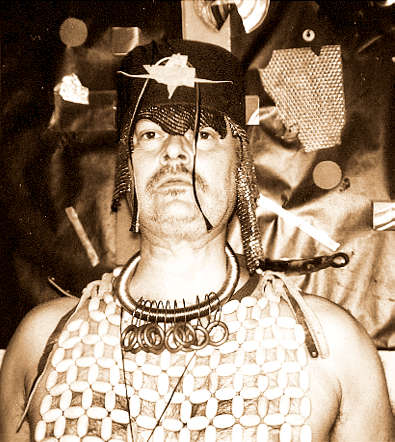
What is avantgarde? I ask myself while sitting with avant-garde sculptor, musician, poet and theatre man Yuriy Zmorovych in his chaotic but very cozy studio in central Kyiv. Books, sculptures, self-made instruments, videotapes, DVDs and vinyl records are stacked in a very wayward regime only known by Yuriy. How should I manage to explain the greatness, humor and the presence of this man’s work, by just using some few words? I ask myself further. For many the term avant-garde have elitistic, pretentious and even obsolete conjections. But Yuriy Zmorovychs avantgarde do not fit into this description. His avantgarde expression is playful, intelligence which feels current and contemporary, without being pretentious. It must be the humor that is key to, I think, for Yuriy has no problem laughing captivating when he talks about his own creations and ideas.
ЮРИЙ ЗМОРОВИЧ / YURIY ZMOROVYCHYuriy Zmorovych has a great production. He began his career as an improviser in early 1970s. And in the early 1980s, he met the Russian musician and avantgardist Sergei Letov. This meeting has led to several collaborations, but in the beginning it was actually mainly film-making and Yuriy made two films together with Letov, improvised on the theme of creation.
In the 1990s he started to work with international artists and one of the more memorable was when he worked with the French group improvisation ARFI. (ARFI stands for Association à la recherche d’un Folklore imaginaire.) In a few weeks in August 1991 they played on a river boat that went from Kiev to Odessa. Between their improvisations, they all sat like glued in front of the radio and listened to the reports on events from Moscow. It was the time when the Soviet Union fell apart.
In constant opposition
For Yuriy, this was symbolic. He went on his river boat and broke new ground, or traveling in new waters, with avantgarde musicians who had similar views on the creation of his own. And in then same time Soviet Union came to an end. For him, avantgarde must constantly stands in opposition to the norm, fighting oppression and those who exercise power.
It was never easy to be improvisational in the Soviet Union, he says, adding that it is of course much easier for young people today to choose that path. Jazz was, for example, prohibited, and he tells emphatically how he, after several years of searching, found “A Drum Is a Woman” by Duke Ellington on a black market in Odessa.
– Duke Ellington had a great spontaneity and it has always been fruitful for my own creativity. But since I came into improvised jazz and avant-garde, I must admit that I abandoned him to others. Along with the Dadaism and Malevich, Ellington are my icons, Yuriy implies.
Yuriy would not want to notify other sources of inspiration, and responds that it could be anything. The rain, a cat jamar, no talking, cars driving along the street, or an internal flow.
The key to the avantgarde expression, according to Yuriy to listen to the spontaneous creative process, to dare to open the doors to the inner voice and not be afraid of what you hear, and the second cornerstone of the avantgarde expression is that always stand in opposition against the norm. This expression is found in the inner voice if you just listen, he says.
His untuned piano was a great beginning
Already in the beginning, in 1970s, his drive was to create a kind of noise generator or stream from the innermost of the soul and the body. He says that he therefor began to play on an untuned piano. An excellent choice, Yuriy implies.
– In my ears it sounded accurate, of course, he laughs.
YURIY ZMOROVYCHBy then he started to build his own instruments. The material was everything he found around him. Metal, plastic, cloth, paper, combined with a guitar string can make miracles.
– Like this, he says and picks up an old plastic bottle with a round hole in the middle. Through the plastic bottle, he has strained a guitar string. When he plays on the string, while screws on the cap, it sounds actually strangely surreal.
Avantgarde theater
In the 1990s Yuriy had the opportunity to become the creative leader for avantgarde theater Teatr AA. His partner was Olexandr Nesterov (link in Ukrainian), a legendary avantgarde guitarist and composer who dead in 2005. They worked with both amateur and professional actors. Important for the project was to lead the actors to learn to play instruments, and to act spontaneously, to improvise. This was not always easy, since many were trained actors. To release an already learned knowledge of how acting should be is not easy, says Yuriy.
In Memoriam Nesterov – with Kiritchenko, Коtrа, Zagaykevych, Letov, Makarov, Borisov, Yaremchuk, Tovstukha, Khmelyov, Ohrymchuk, Strelnikov, Klymenko, Zmorovych, Smetanin, Rudyi, Putyatin, Khmelyov, Makhno. NOTE! You hear Zmorovych in the second piece (if ou have any problem hearing it here, go to the website, see the link above) and not on the first, that is Yuriy Yaremchuck performing!
Teatr AAA got much attention, not only in former Soviet Union but also in Western Europe and the USA. But during the crisis years of the 1990s the sponsors fled and the theater had to be closed.
“Avantgarde should never be decorative”
Yuriy loves to to work with amateurs. He argues that the most important thing is to be creative and to be self-taught and that does not necessarily mean that you do not know how to create. He argues that many musicians or artists in avantgarde often are overly decorative in their design and not in opposition to the norm. He points a little at his compatriot Yuriy Jaremchych, he also worked with previously. But they have chosen different ways and is therefore not entirely agree on the avantgarde expression. At the same time Yuriy Zmorovych would never allow condemnation against other artists.
I ask him what he thinks about the future and he urge that he believes that a new generations will bring avantgarde further to new dimensions. The forms will of course be different, but the most incentives will stand.
– The human mind is collective, and our knowledge is shared. New influences will of course be added as our lives are changing. These are doors that the avantgardist should open. But how it will be can only the future reveal, he concludes.
And I am really feel enthusiastic by his optimism.
Ya Gallery is clearly something beyond the ordinary. That stands clear after only a short meeting with its founder Pavlo Gudimov. Pavlo’s ambitions for Ya Gallery is anything but insignificant. He wants to bring large footprint on the Ukrainian art scene, not just here and now but in a very distant future.
But last fall Ya gallery unexpectedly came into the limelight. the gallery was burned down by an angry crowd. There has been a rumor afterwards that there was an exhibition about homosexuality, that caused the attack, but this was not the case. The trigger for the riot was that Ya gallery agreed to host a panel discussion, led by a gay organization, on the situation of homosexuals in today’s Ukraine.
– They had nowhere to have their meeting, so we let them use our gallery for their panel discussion. But apparently it was too delicate issue and many was provoked, says Pavlo. I’m pretty sure that anything like this could never happen in Sweden, right?
The young artist Volokitin Artem, who exhibited at the time of the attack, does not focus on homosexuality, even though his work can be provocative, though hardly by the tangent to a homosexual theme.
Artem Volokitin receives the PinChukArtPrize
Pavlo implies, however, that both Artem and Ya Gallery benefited from the attack. Both received attention and therefore got a new audience. But the gay situation is still difficult, said Pavlo.
Ya Gallery opened three years ago, but Pavlo founded a design workshop, or showroom, already 8 years ago. Ya gallery’s idea is to be able to work with the whole process, from the exhibition to the designing and printing the posters, the catalogs. Pavlo has tied five companies to Gudimov art project. They are publisher, designer or involved in contemporary art. He also implies that a major problem for contemporary art in Ukraine is that there is no infrastructure for art and artists. He hope that he with Gudminov art project can change that sitaution. Pavlo also stresses that the cross-disciplinary idea in Gudminov art project is what makes it strong. It creates a new creative environment and pioneering ideas cant there be created. Gudminov art projects publications is also the main sources of income and helps Ya Gallery to exist.
Ya Gallery with Pavlo Gudminov at the helm, also wants to change, influence and even to some extent determine how the Ukrainian art scene will look like in the future. Pavlo goes round the country to search for artists, young and old. The art he chooses is the one that does not trample already beaten tracks and he would not favor a few artists.
– Many galleries run only around 10 artists, but I want to have a broader base than that, he says.
He is not afraid to exhibit artists that never have had any exhibition. When I visited Ya gallery they exhibited two artists, two men in their 50s, that never had been exhibited before.
– They have an expression that fits our concept, says Pavlo.
– What do you mean by concept? I ask. That it is “Ukrainian” and fits the subtitle of “contemporary Ukrainian art”?
– Well, says Pavlo. The term “contemporary Ukrainian art” is an effort to give Ukrainian art a game room or space. And I want to help creating the content of that space.
– But is not “Ukrainian” just a word in vogue right now? What if it suddenly becomes obsolete, or really lame?
– Yes, I can admit that it is true, and to some extent we are using it as smart marketing. It gives the right sense, so to speak. We of course also sets out international artists. But there is also a huge lack of knowledge about Ukraine’s art scene, both inside and outside its borders. Can we participate in creating a knowledge bridge between artists and their audience I will be satisfied, concludes Pavlo before he hastens off to the next meeting.
viewpoint-east.org kan stolt presentera ett nytt bidrag av Maria Nilsson. Nu om fördomar och rysskräck i bland annat (så dagsaktuella) OS-sammanhang.
Vem har sagt att det är enkelt att vara slavist, eller mindre akademiskt uttryckt rysskramare eller öststatsälskare? Det är aldrig tydligare än när det är dags för OS eller annat stort sportevenemang och framför allt i individuella sporter där svenskarna har, eller i alla fall har haft stora framgångar.
Vem som helst kan i allmänhet uppskatta det vackra rörelsemönstret hos en konståkare som Evgenij Plushenko, utsökta dribblingarna av en Andreij Arshavin eller en Elena Isinbajevas (dessutom har hon ju samma manager som Christian Olsson) förmåga att hela tiden slå nya världsrekord men den längdskidåkare eller skidskytt från forna Öst som skidar förbi en Charlotte Kalla eller skjuter bättre än en Helena Jonsson finner aldrig nåd hos den svenska publiken. Finns det någon gång man kan fråga sig om muren överhuvudtaget fallit är det i längdskidspåret eller i skidskyttetävlingar. Aldrig är väl uppdelning mellan öst och väst dvs. ont och gott så tydlig som i dessa avseende.
Uppkrupen i ett hörn i ett stort sällskap mumlar du förklaringar till varför ryska namn är så konstiga och i allmänhet feluttalade av kommentatorer, försöker glatt dra på munnen när sällskapet skämtar kring att Belarusier och Ryssar inte får komma hem om de gör en dålig tävling eller snarare blir förvisade till Sibirien och framför allt anstränger dig för att inte göra det till ett statsvetenskapligt problem när någon poängterar hur mycket bättre det var när Sovjet fanns och det då fanns fem åkare istället för dagens 35.
I händelse av en ”Öststats” seger ställer sig alla kollektivt upp och skriker epo medan du lite försynt förklarar att enbart för att ryska tävlande blivit ertappade som dopade vid fler tillfällen än de allestädes samvetsgranna svenskarna behöver det inte betyda att alla på andra sidan Donau knaprar piller morgon, middag och kväll. Det kan ju faktiskt vara så att tävlande från det som i det här sammanhanget så gärna benämns som forna Öst faktiskt är bättre tränade, bättre på att toppa formen, bättre på att hålla nervositeten stången osv. än sina svenska motsvarigheter.
Alla som någon gång rest i det forna Öst eller har vänner som kommer därifrån vet om den benhårda disciplin som alla barn grillas i oavsett om det handlar om tämligen oskyldiga fritidssysselsättningar eller prestationsinriktade sporter. Det var en av många paradoxer med landet bakom järnridån, alla skulle vara bäst samtidigt som det kollektiva alltid skulle segra över det individuella. Alla som någon gång har befunnit sig i en träningshall i Öst under vintern vet också om den skoningslösa kylan, avsaknaden av varmvatten i duscharna och möglet i omklädningsrummet vilket antagligen är mer karaktärsdanande än de svenska motsvarigheterna. Till dess att jag blir motbevisad av dopingkontroller kommer jag därför att fortsätta glädjas i smyg i mitt soffhörn vid en ”Öststatsseger”.
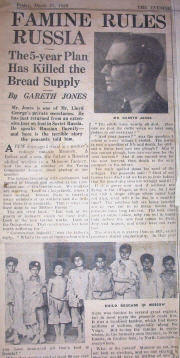
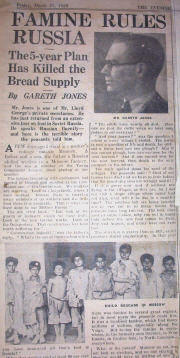
Gareth Jones was a Welsh journalist that was the first to publish articles about Holodomor in Western media. He alos claimed that the Soviet regime and the 5-year plans deliberately made the suffering worse. This lead to many accusations from Moscow, but also from other journalists. Even New York Times called him a liar. His diaries, where he noted everything that he saw when he travelled through Ukraine during 1930s and the time for the Holodomor, was the of course one very important part of the exhibition that Cambridge Ukrainian studies organized.
This website uses cookies to improve your experience. We'll assume you're ok with this, but you can opt-out if you wish.AcceptRejectRead More
Privacy & Cookies Policy
Privacy Overview
This website uses cookies to improve your experience while you navigate through the website. Out of these, the cookies that are categorized as necessary are stored on your browser as they are essential for the working of basic functionalities of the website. We also use third-party cookies that help us analyze and understand how you use this website. These cookies will be stored in your browser only with your consent. You also have the option to opt-out of these cookies. But opting out of some of these cookies may affect your browsing experience.
Necessary cookies are absolutely essential for the website to function properly. This category only includes cookies that ensures basic functionalities and security features of the website. These cookies do not store any personal information.
Any cookies that may not be particularly necessary for the website to function and is used specifically to collect user personal data via analytics, ads, other embedded contents are termed as non-necessary cookies. It is mandatory to procure user consent prior to running these cookies on your website.