Category: art

  • Yuriy Zmorovych: “An avantgardist should always be in opposition to the norm”

    Yuriy Zmorovych: “An avantgardist should always be in opposition to the norm”

    Läsningstid: 5 minuter

    Read the Swedish version here.

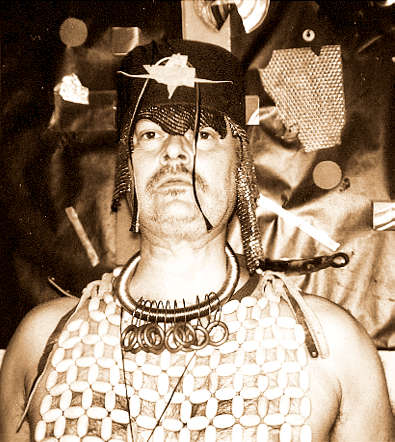
    What is avantgarde? I ask myself while sitting with avant-garde sculptor, musician, poet and theatre man Yuriy Zmorovych in his chaotic but very cozy studio in central Kyiv. Books, sculptures, self-made instruments, videotapes, DVDs and vinyl records are stacked in a very wayward regime only known by Yuriy. How should I manage to explain the greatness, humor and the presence of this man’s work, by just using some few words? I ask myself further. For many the term avant-garde have elitistic, pretentious and even obsolete conjections. But Yuriy Zmorovychs avantgarde do not fit into this description. His avantgarde expression is playful, intelligence which feels current and contemporary, without being pretentious. It must be the humor that is key to, I think, for Yuriy has no problem laughing captivating when he talks about his own creations and ideas.
    ЮРИЙ ЗМОРОВИЧ / YURIY ZMOROVYCH
    ЮРИЙ ЗМОРОВИЧ / YURIY ZMOROVYCH
    Yuriy Zmorovych has a great production. He began his career as an improviser in early 1970s. And in the early 1980s, he met the Russian musician and avantgardist Sergei Letov. This meeting has led to several collaborations, but in the beginning it was actually mainly film-making and Yuriy made two films together with Letov, improvised on the theme of creation.

    In the 1990s he started to work with international artists and one of the more memorable was when he worked with the French group improvisation ARFI. (ARFI stands for Association à la recherche d’un Folklore imaginaire.) In a few weeks in August 1991 they played on a river boat that went from Kiev to Odessa. Between their improvisations, they all sat like glued in front of the radio and listened to the reports on events from Moscow. It was the time when the Soviet Union fell apart.

    In constant opposition
    For Yuriy, this was symbolic. He went on his river boat and broke new ground, or traveling in new waters, with avantgarde musicians who had similar views on the creation of his own. And in then same time Soviet Union came to an end. For him, avantgarde must constantly stands in opposition to the norm, fighting oppression and those who exercise power.

    It was never easy to be improvisational in the Soviet Union, he says, adding that it is of course much easier for young people today to choose that path. Jazz was, for example, prohibited, and he tells emphatically how he, after several years of searching, found “A Drum Is a Woman” by Duke Ellington on a black market in Odessa.

    – Duke Ellington had a great spontaneity and it has always been fruitful for my own creativity. But since I came into improvised jazz and avant-garde, I must admit that I abandoned him to others. Along with the Dadaism and Malevich, Ellington are my icons, Yuriy implies.

    Yuriy would not want to notify other sources of inspiration, and responds that it could be anything. The rain, a cat jamar, no talking, cars driving along the street, or an internal flow.

    The key to the avantgarde expression, according to Yuriy to listen to the spontaneous creative process, to dare to open the doors to the inner voice and not be afraid of what you hear, and the second cornerstone of the avantgarde expression is that always stand in opposition against the norm. This expression is found in the inner voice if you just listen, he says.

    His untuned piano was a great beginning
    Already in the beginning, in 1970s, his drive was to create a kind of noise generator or stream from the innermost of the soul and the body. He says that he therefor began to play on an untuned piano. An excellent choice, Yuriy implies.

    – In my ears it sounded accurate, of course, he laughs.
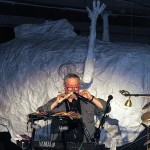
    YURIY ZMOROVYCH
    YURIY ZMOROVYCH
    By then he started to build his own instruments. The material was everything he found around him. Metal, plastic, cloth, paper, combined with a guitar string can make miracles.

    – Like this, he says and picks up an old plastic bottle with a round hole in the middle. Through the plastic bottle, he has strained a guitar string. When he plays on the string, while screws on the cap, it sounds actually strangely surreal.

    Avantgarde theater
    In the 1990s Yuriy had the opportunity to become the creative leader for avantgarde theater Teatr AA. His partner was Olexandr Nesterov (link in Ukrainian), a legendary avantgarde guitarist and composer who dead in 2005. They worked with both amateur and professional actors. Important for the project was to lead the actors to learn to play instruments, and to act spontaneously, to improvise. This was not always easy, since many were trained actors. To release an already learned knowledge of how acting should be is not easy, says Yuriy.


    In Memoriam Nesterov – with Kiritchenko, Коtrа, Zagaykevych, Letov, Makarov, Borisov, Yaremchuk, Tovstukha, Khmelyov, Ohrymchuk, Strelnikov, Klymenko, Zmorovych, Smetanin, Rudyi, Putyatin, Khmelyov, Makhno. NOTE! You hear Zmorovych in the second piece (if ou have any problem hearing it here, go to the website, see the link above) and not on the first, that is Yuriy Yaremchuck performing!

    Teatr AAA got much attention, not only in former Soviet Union but also in Western Europe and the USA. But during the crisis years of the 1990s the sponsors fled and the theater had to be closed.

    “Avantgarde should never be decorative”
    Yuriy loves to to work with amateurs. He argues that the most important thing is to be creative and to be self-taught and that does not necessarily mean that you do not know how to create. He argues that many musicians or artists in avantgarde often are overly decorative in their design and not in opposition to the norm. He points a little at his compatriot Yuriy Jaremchych, he also worked with previously. But they have chosen different ways and is therefore not entirely agree on the avantgarde expression. At the same time Yuriy Zmorovych would never allow condemnation against other artists.

    I ask him what he thinks about the future and he urge that he believes that a new generations will bring avantgarde further to new dimensions. The forms will of course be different, but the most incentives will stand.

    – The human mind is collective, and our knowledge is shared. New influences will of course be added as our lives are changing. These are doors that the avantgardist should open. But how it will be can only the future reveal, he concludes.

    And I am really feel enthusiastic by his optimism.
  • Ya Gallery wants to make a difference

    Läsningstid: 3 minuter

    This article was previously published in Swedish.

    Ya Gallery is clearly something beyond the ordinary. That stands clear after only a short meeting with its founder Pavlo Gudimov. Pavlo’s ambitions for Ya Gallery is anything but insignificant. He wants to bring large footprint on the Ukrainian art scene, not just here and now but in a very distant future.

    But last fall Ya gallery unexpectedly came into the limelight. the gallery was burned down by an angry crowd. There has been a rumor afterwards that there was an exhibition about homosexuality, that caused the attack, but this was not the case. The trigger for the riot was that Ya gallery agreed to host a panel discussion, led by a gay organization, on the situation of homosexuals in today’s Ukraine.

    – They had nowhere to have their meeting, so we let them use our gallery for their panel discussion. But apparently it was too delicate issue and many was provoked, says Pavlo. I’m pretty sure that anything like this could never happen in Sweden, right?

    The young artist Volokitin Artem, who exhibited at the time of the attack, does not focus on homosexuality, even though his work can be provocative, though hardly by the tangent to a homosexual theme.


    Artem Volokitin receives the PinChukArtPrize

    Pavlo implies, however, that both Artem and Ya Gallery benefited from the attack. Both received attention and therefore got a new audience. But the gay situation is still difficult, said Pavlo.

    Ya Gallery opened three years ago, but Pavlo founded a design workshop, or showroom, already 8 years ago. Ya gallery’s idea is to be able to work with the whole process, from the exhibition to the designing and printing the posters, the catalogs. Pavlo has tied five companies to Gudimov art project. They are publisher, designer or involved in contemporary art. He also implies that a major problem for contemporary art in Ukraine is that there is no infrastructure for art and artists. He hope that he with Gudminov art project can change that sitaution. Pavlo also stresses that the cross-disciplinary idea in Gudminov art project is what makes it strong. It creates a new creative environment and pioneering ideas cant there be created. Gudminov art projects publications is also the main sources of income and helps Ya Gallery to exist.

    Ya Gallery with Pavlo Gudminov at the helm, also wants to change, influence and even to some extent determine how the Ukrainian art scene will look like in the future. Pavlo goes round the country to search for artists, young and old. The art he chooses is the one that does not trample already beaten tracks and he would not favor a few artists.

    – Many galleries run only around 10 artists, but I want to have a broader base than that, he says.

    He is not afraid to exhibit artists that never have had any exhibition. When I visited Ya gallery they exhibited two artists, two men in their 50s, that never had been exhibited before.

    – They have an expression that fits our concept, says Pavlo.

    – What do you mean by concept? I ask. That it is “Ukrainian” and fits the subtitle of “contemporary Ukrainian art”?

    – Well, says Pavlo. The term “contemporary Ukrainian art” is an effort to give Ukrainian art a game room or space. And I want to help creating the content of that space.

    – But is not “Ukrainian” just a word in vogue right now? What if it suddenly becomes obsolete, or really lame?

    – Yes, I can admit that it is true, and to some extent we are using it as smart marketing. It gives the right sense, so to speak. We of course also sets out international artists. But there is also a huge lack of knowledge about Ukraine’s art scene, both inside and outside its borders. Can we participate in creating a knowledge bridge between artists and their audience I will be satisfied, concludes Pavlo before he hastens off to the next meeting.

  • State of Mind – By Annica Karlsson Rixon & Anna Viola Hallberg

    State of Mind – By Annica Karlsson Rixon & Anna Viola Hallberg

    Läsningstid: 11 minuter

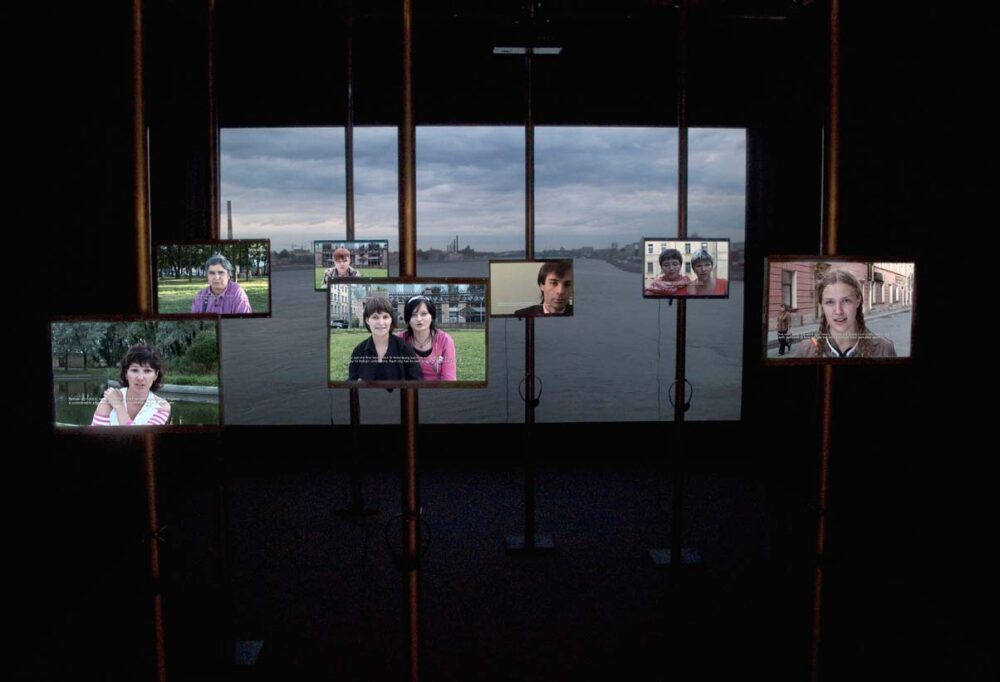
    This essay by Annica Karlsson Rixon and Anna Viola Hallberg is about their installation project State of Mind. It has been exhibited in Stockholm, S:t Petersburg and Kiev, just to mention some. State of Mind will be exhibited at Y Gallery in Minsk, Belarus in March 2010.

    Download full pdf here.

    Acquiring direction

    ‘Life itself’ is often imagined in terms of ‘having a direction’, which decides from the present what the future should be. After all, to acquire a direction takes time, even if it feels as if we have always followed one line or another, or as if we ‘began’ and ‘ended’ at the same place. Indeed, it is by following some lines more then others that we might acquire our sense of who it is that we are.
    Sara Ahmed Queer Phenomenology. Duke University Press. 2006.

    The writing of this text started at the end of July, a few days after installing State of Mind, for the first time, in the context of EuroPride 08 in Stockholm. [Kulturhuset – Stockholm, July 25 – August 25, 2008. State of Mind is exhibited together with Resonanse at ROSPHOTO – the Russian state center of photography in St. Petersburg, September 5 – October 5, 2008. A tour is planned for Kiev and Kharkov, Ukraine in 2009 and then to move onwards.] The setting for this opening forms an accentuated framework for the narrative, it becomes a component of history writing and an illustrative element for media in the reporting on the event focusing on the themes of the festival; “breaking borders” [The theme for EuroPride in Stockholm 2008 is “Swedish Sin, Breaking Borders”.], bridging politics, culture and entertainment.

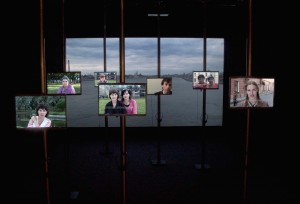
    State of Mind (Installation view) State of Mind consolidates to a trilogy together with Resonance and Code of Silence. In different ways these lens-based art installations cast light on aspects of socially and culturally constructed identity-based groups in contemporary society. Photography and video are used in combination to expand on the separate histories of the two media with regard to interviews and portraits in documentary genres. This is the point of departure for all three installations. As for the overall narrative, the topics of how and why different groupings construct networks and communities in order to achieve a sense of belonging are in focus, as well as the conditions and necessities for forming the community. The projects look at the social conventions family, love and career, dealing with power relations such as gender, ethnicity, sexual orientation and class. The method of collecting the material in fieldwork is similar in the three projects, but the questions asked and issues raised are specific to each segment of the installations. Portraiture and personally based stories are central. The trilogy is presented as three separate art installations, which co-exist and cross-inform each other. They reflect upon civil rights issues and the idea of being safe and productive within society, working in the space between personal choice and social expectations. Memory, narration, visual representation and oral history are central. In each of the three works a different group is approached that relates to the artists’ personal lives. Resonance [Resonance was exhibited at Norrköping Art Museum, Göteborgs Konsthall and Uppsala Museum of Art during 2006-2007.], our first collaboration, is based on a network of peers belonging to a successful generation of artists and curators. They are all women who made an entrance onto the Swedish and Danish art scene in the 1990´s, and now have international careers. On one level Resonance is an examination of the Scandinavian welfare state, and in more specific terms, the impact of the conditions it creates for the portrayed women to make it on the art scene. In Code of Silence [Code of Silence will be ready to be launched in 2009.] this is a sibling group of five who grew up on a small farm in rural Gothenburg, Sweden. The farm had to face the challenge of major cultural reforms in the nineteenth century, but remained intact. It became a target for expropriation during the 1950´s and 70´s to make way for the reforms involved in building the modern Sweden. Hence, it remained an object of possible interest for the national cultural heritage. The farm was finally demolished in 2004. Code of Silence is based on oral history, memories told by the siblings infringing the UN’s Declaration of Human Rights paragraph 17 relating to everyone’s right to a home. In addition this installation includes a large number of private and official documents such as hand-written wills, receipts from selling milk, and letters to the King of Sweden. State of Mind explores everyday life and the boundaries between ethics, legislation, prejudice and civic expectations in the LGBTQ [Lesbian, Gay, Bisexual, Transsexual, Queer] life of St. Petersburg, Russia. It emphasizes individuals identifying as lesbians or bisexual women.

    (more…)

  • Ya Gallery gör skillnad

    Läsningstid: 3 minuter

    Att Ya Gallery är något utöver det vanliga står helt klart efter bara en kort stunds möte med dess grundare och ledstjärna Pavlo Gudimov. För Pavlos ambitioner för Ya Gallery är allt annat än ringa. Han vill sätta stora avtryck, inte bara här och nu, utan även i en mycket avlägsen framtid.

    Men i höstas hamnade galleriet i helt oväntat i rampljuset när det brändes ned av en uppretad folksamling. I efterhand har det uppstått ett rykte att det var en utställning om homosexualitet som orsakade attacken, men så var inte fallet. Orsaken till folkmobben vrede var att Ya gallery lät husera en paneldebatt om situationen för homosexuella i dagens Ukraina ledd av en Gay organisation.

    – De hade ingenstans att ha sitt möte, och vi såg inget hinder med att låta dem använda vårt galleri för deras paneldebatt. Men tydligen var det för känsligt, förklarar Pavlo. Jag är ganska säker att något liknande aldrig skulle kunna hända i Sverige, avslutar han.

    Den unge konstnären Volokitin Artem, som ställde ut vid tillfället för attentatet, behandlar inte homosexualitet, även om hans verk vid en snabb betraktelse kan vara något provocerande, men knappast genom att det tangerar ett homosexuellt tema.


    Artem Volokitin får PinChukArtPrize

    Pavlo menar dock att både Artem och Ya Gallery har fått upprättelse och till och med tjänat på attentatet. Båda fick uppmärksamhet och fick därför en ny publik. Men de homosexuellas situation är oförändrat svår, så där har inte positivt hänt, säger Pavlo.

    Ya Gallery har funnits i tre år, men Pavlo har drivit andra verksamheter tidigare. För 8 år sedan grundade han en design workshop, eller showroom. Det är kanske Ya Gallery har en så bred bas. Pavlo har med företaget Gudimov art project knutit fem företag till sig. De är förläggare, designer eller sysslar med samtida konst på något annat vis. På det sättet kan de sköta hela marknadsföringskedjan för Ya Galleri och Pavlo menar att ett stort problem för samtida konst är att det inte finns någon infrastruktur fört konst och konstnärer. Pavlo poängterar också att korsbefruktningen mellan de olika disiplinerna inim Gudminov art project är mycket viktig. Det skapar en kreativ miljö och nya tankar skapas. Dessutom är publikationer Gudminov art projects största inkomsts källa och det är den som hjälper Ya Gallery att existera.

    Ya Gallery med Pavlo Gudminov i spetsen, vill förändra, påverka och även i viss mån anvgöra hur den ukrainska konstscenen borde se ut i framtiden. Pavlo åker runt i landet för att söka upp konstnärer, unga eller gamla spelar ingen roll. Det viktiga för Pavlo är att inte trampa i redan upptrampade spår. Han vill inte heller favorisera ett fåtal konstnärer.

    – Många gallerier kör bara med runt 10 konstnärer, men jag vill ha en bredare bas än så, säger han.

    Han räds inte heller att ta en helt oprövade kort. Just i skrivande stund ställer de ut två till åren komna konstnärer. De har aldrig ställt ut tidigare, men det hindrar inte Ya Gallery.

    – De har ett uttryck som passar vårt koncept, säger Pavlo.

    – Vilket koncept, måste jag då fråga. Att det är “ukrainskt” och passar en undertitel “contemporary Ukrainian art”?

    – Nja, säger Pavlo. Termen “contemporary Ukrainian art” är ett försök att ge ukrainsk konst ett spelrum eller utrymme. Och jag vill ju vara med att skapa innehållet i det utrymmet.

    – Men är inte “ukrainskt” bara ett ord på modet här i Ukraina? Vad händer om det plötsligt blir föråldrat eller riktigt töntigt?

    – Ja, jag kan erkänna att det är sant, och att vi i viss mån använder det som smart marknadsföring. Det ger rätt känsla, så att säga. Vi ställer ju dessutom ut internationella konstnärer, ler Pavlo. Men det råder också en enorm okunskap om Ukrainas konstscen, både inom och utom landets gränser. Kan vi vara med och skapa en kunskapsbrygga mellan konstnärerna och deras publik, så är jag nöjd, avslutar Pavlo innan han hastar iväg till nästa möte.

  • On what a naked body can do

    Läsningstid: 3 minuter

    It was a couple of days ago I started to think about Boris Mikhailov again – the photographer, not the ice hockey player ; ) My first acquaintance with him and his photos was at a Photo Fair in Gothenburg. I guess it was in the late 1990s. The collection of his photos was not any his more wild and exposing photos, but the old hand coloured. I also saw them in Moscow a couple of years ago and got as equally impressed. It is a fascinating work. But it was a completely different story when I really fell in love with his work. It was when he got the Hasselblad Award in 2000. I had been able to grab a ticket to the award ceremony, and the so called party afterwards at the local City Art Hall.

    mikhailov

    When I was walking around that City Art Hall I slowly started to grasp what kind of photographer this was! I was completely stunned with his serie with the homeless, alcoholics and drug addicts. Not only was he brave, but also the people he depicted was so. At first I wasn’t very sure if I liked it or not. I thought he exploited the people somehow but I couldn’t put my finger on if I thought it was entirely bad and evil action to do so. But when I came to the last room, I was not very sure what to think at all. It was a serie with self portraits, mostly naked and not in an euphemistically way. His aging body was put in more or less obscure positions. It was something very laughable about it, as it was extremely admirable! He deconstructed his own body, and I both liked and feared. It was like his work spoke two different languages, both brutal and very subtle in the same breath. I was completely entranced by him and his way of thinking, but I still feel have problem describing why, and actually how, I love his work.

    Here is an interview with Boris Mikhailov on “Specialisten”.

    A couple of years ago a friend from Moscow visited me and we started to talk about Mikhailov. I think we both shared a common admiration for him, but probably in different ways. My friend told me that Mikhailov had been arrested in Kyiv (and released shortly after) due to that he and his assistant had been collecting women’s sanitary pads at public toilets. They needed it for some kind of project that Mikhailov was working on. I still don’t know if it true or not. And parts of me does not want to know either, because I fear it does not exists at all. But if it does, I am convinced that we will most certainly hear about it. It would be pretty controversial … And if it does exist, I will probably dispute with myself if I like it or not, possibly ending up entranced, once more.