Archive for the 'guests' Category

EU and UK visa policy towards Ukrainians – ‘go back to Russia!’ (?)

The shameful treatment of Ukrainians by the Schengen and UK visa systems continues to hit new heights, with at least two more atrocious stories emerging this week.

The UK’s Independent highlighted the rejections of visas for Ukrainian children who were due to spend a month away from the vicinity of Chernobyl. Whether these trips are healthwise still strictly necessary is open to question, but the point is that these summer trips have gone on for years without any problems. In just one example, only 7 out of 17 children due to spend part of the summer on the Isle of Wight were permitted to travel and, to make matters worse, they were in some cases informed only the night before travelling, with suitcases packed, that they would not be making the trip. The UK Border Agency tried to blame it on unsuitable host families in the UK, but the claims seem to be spurious.

Chernobyl/Pripyat Exclusion Zone (083.8244)
Photo from Chernobyl by Pedro Moura Pinheiro.

Another case highlighted this week was of two PhD students bound for Italy who had their student visas rejected. There is an exhaustive list of similar cases, including the Ukrainian dance troupe which protested against their UK visa rejections by performing outside the British Embassy in Kiev. A folk festival in Bellingham had been deprived of the same pleasure. A recent article in the Kyiv Post highlighted an unfortunate Ukrainian student’s extended stay in the departure lounge of Paris Charles de Gaulle airport due to the Icelandic volcano. The fact that he had friends in nearby Paris and was on a US student visa cut no ice with the French authorities despite clear evidence in favour of the applicant. Another case brought to my attention by my father was a group of Ukrainian steam train operators which was prevented from attending a gathering of railway preservationist organisations in Hungary. The gathering was part of the process of trying to bring Ukrainians round to creating the kind of railway preservation projects which have grown tourism in myriad places across the continent. Such developments are fairly alien in somewhere like Ukraine, but these are good examples of how visa rejections will serve to reinforce the status quo.

One not to be ignored result of this policy is the stress that it has caused to EU citizens in each case. With cases of a more personal nature this stress is amplified. In such cases the inviting party is treated as irrelevant to the matter in hand or even worse, de facto made out to be liars. These rejections are damaging business, cultural, educational, family and personal contacts of EU citizens. Don’t we have rights too?

With the common thread here seeming to be the apparently arbitrary nature of many visa rejections, does it smack of conspiracy theories to begin to question whether there is a more sinister motive at work here? Are the EU and UK in fact telling Ukrainians in fairly blunt terms to ‘go back to Russia’? The line has been drawn and, sorry, you’re on the Moscow side. If this is not the message they wish to give out, they’re not doing a very good job!

This was previously published at Chicken in Kiev.

Jonathan Hibberd recently completed post-graduate studies at Sussex European Institute, University of Sussex in the UK and has carried out research into questions of Ukraine’s European integration and the country’s relationship with NATO. He currently works with the British Council in Kiev.

Cops on Fire: The True Story

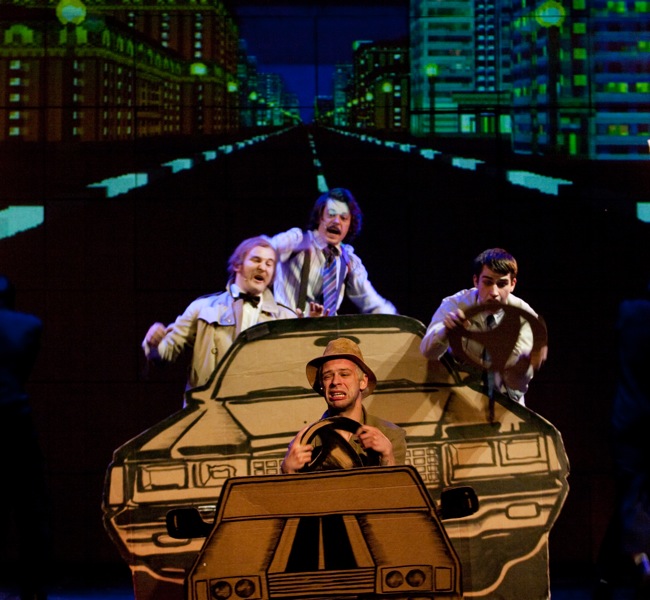
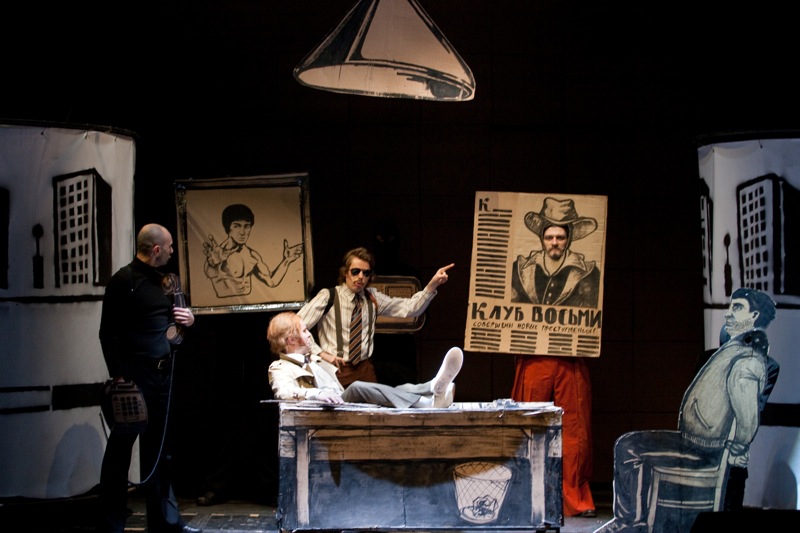
The Cops on Fire-story started more than a year ago. One evening I met my friend Sasha Kholenko (DZA) in the 16tonns cafe in Moscow, the club where DZA together with how2make-crew made concerts and gigs during the time. He told me about one of his projects, a radio play based on a detective story about cops and killers. The play included more than 30 hip-hop tracks, each track was a short episode in the play. DZA made all the beats and loops for that project called “Cops On Fire”. He asked if I want to meet the other guys in the project, and make this on stage and not only on radio.

So, why did he ask me? At that moment I was working with the theatre group  ”Le Cirque de Sharles La Tannes”. In 2005 we staged The Crystal World, a short story by Victor Pelevin. The interesting thing was that all the music for The Crystal World was composed by another member of how2make-crew, the talanted electronic musician Roma Litvinov (Mujuice). It felt like a good chance to make another experiment with how2make-crew on stage. But now with hip-hop.

So we started to work…

We had however no budget. So by the time we had the idea of how it could be on stage, we started search for sponsor. We thought we needed more or less 8000$ for the whole production. (Finally it costed more than 10000$). But we failed to find any sponsor. Probably we didn’t try hard enough. Everyone was eager to start the production and rehearsals as soon as possible, and to search for sponsors are a rather boring work. So we, me and my partner, Jury Kvyatkovsky (the director of “Cops On Fire”) invested our own money. But many helped. One of our friends proposed us a studio for the rehearsals, another found some costumes, another made the decorations on credit. And in September last year we had a call from S:t Petersburg and they invited us to the Sergey Kuryokhin Festival. We agreed and had only two months to finish everything.

The premiere in St.Petersburg was very sucessful. Even though we didn’t like the technical result – the place was a cinema but we prefer a theatre. The audience loved it though. Directly after that we started to work with the Moscow premiere and tried to make it in the best possible way. After several months of working it seemed as everyone finally started to believe in what they were doing. The premiere in Moscow got only one negative comment and that was that we used to much slang and bad language in the play, and we have now cut some of those.

However, the most interesting thing with our project is that we, subconsciously, have made a very social and actual project. In Russia there were several scandals connected to the police last year. There where for instance a shooting at a supermarket by a Major Evsukov and a video message for Medvedev. Our story is opposed to real life with the most fair cop. He is a true social order keeper. He spares no effort to put his vision of what’s right and what’s wrong into practice. Still there are very few comments from theatre audience about this connection.

“Cops on Fire” gives two shows every month in Moscow at the theatre centre “Na Strastnom”. In June it will be the 10th show in Moscow. Each time the house is full. About 3000 people have seen the show so far. In May “Cops On Fire” gave a live show on “TransMusicales” festival, and in September we will take part in international theatre festival GOGOLFEST in Kiev, Ukraine. And we have also started a film project….

…to be continued…

Cops on fire at facebook

Sasha Pas is art-director of Le Cirque de Sharles La Tannes – an independent creative group of actors, directors, musicians and artisits, based in Moscow, Russia. In past recent years – editor and founder of 55 pdf magazine. Now works as a creative producer of Cops On Fire project.

A Western Coalition? – Western Ukraine needs a new strategy

Where is Western Ukraine in the new political order? You could be forgiven for thinking it had disappeared from the map altogether. The new President has put a Russian in charge of the country, and set out on a course coherent with restoring Ukraine’s place to that of the ‘little Russia’ which had for the past 19 years existed only the minds of out-of-touch, chauvinistic Muscovites. Western Ukraine is now a marginalised and, some would argue, despised frontier province with nothing to offer the new order. It may even now, some might suppose, become the ‘enemy’ on which the need for ‘stability’ (meaning authoritarianism) is sold to the people, in the way that Russia scapegoats the clearly terrifying Estonia and Georgia (and up until now Ukraine) as reasons to stick to ‘strong government’. Egg-throwing and rostrum-blocking in parliament does little to dispel these insinuations.

If the new order is to persist, it poses questions to the west of the country that have never before been so prescient. Independent Ukraine was born of what one might call an unholy alliance between the communists of the east and the nationalists of the west. For many years this grand bargain carried benefits as well as disadvantages for both sides. Whilst an eastern-based business mafia held sway over the country’s industry and economy, a kind of ‘cultural mafia’ advanced a linguistic and cultural agenda that more favoured the west of the country. This grand bargain is now breaking up. Some would say this breaking up was started in the Yushchenko era. Others might contend that it is now, under Yanukovych, that one side of the country feels most disenfranchised. What is clear is that nothing is now being done with the aim of enhancing national unity. Instead of an over-arching, inclusive, reform-minded government under a prime minister such as Tigipko which the most optimistic might have hoped for, the new President has opted for a Russo-centric position. It is difficult to see how divisive appointments such as Tabachnyk can be considered necessary pragmatism. The idea that in the country that suffered the Holodomor children might in the very near future be opening textbooks that state that Stalin was a ‘strong leader who made tough decisions for Russia’ is going to be most sickening to those in the west.


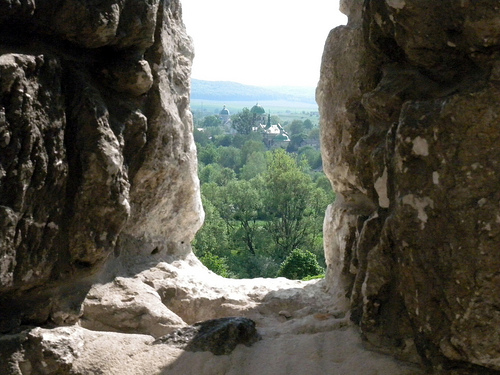
Oleskiy Palace. Photo by Em and Ernie

Part of Western Ukraine’s problem is that the figures they have backed in the past have in fact served the region’s wider interests very poorly. Although large numbers turned out in the presidential second round to support Tymoshenko, there seemed little to recommend her, apart from that she wasn’t Yanukovych. The orange politicians who wrap themselves in Ukrainian patriotism in fact have interests much closer to the centre. At the other extreme, Ukrainian nationalist or patriotic parties can be seen as somewhat eccentric, perhaps extremist, in any case for many people not truly electable. Western Ukraine is clearly different to the rest of the country, culturally and linguistically and in its aspirations. These differences are only being exacerbated in the current circumstances. Western Ukrainians themselves need to start thinking about how to empower themselves against the current unenviable odds. A lot will depend on what sort of system emerges over the next couple of years.

If the current semi-parliamentary system persists, the west might look at its options modelled on regional/cultural political blocks in other European countries. In Italy, the Northern League sheds any illusions that it is a party of national consensus, and seeks to represent its regional interest within the country, where it feels under-represented. In Romania and Slovakia, the Hungarian minority is represented by Hungarian coalition parties. These coalition parties host within them a diverse set of views, from moderates to nationalists, but who manage to agree on over-arching concerns, and lobby for concessions in these areas, frequently as kingmakers in coalitions. Strong patriots might feel a need to prioritise issues such as UPA recognition, but in reality, forsaking the bigger issues over such matters does little to help the next generation. Even the People’s Self Defence block, which is an attempt at coalition party building, does not have a broad enough appeal. As the Conservatives in the UK who are learning coalition politics from scratch now realise, one has to look at the big picture. The over-arching issues for Western Ukrainians are obvious: education and language, relations with Europe and the need for a credible economic development policy for the region. So a kind of ‘Western Coalition’ could be the answer.


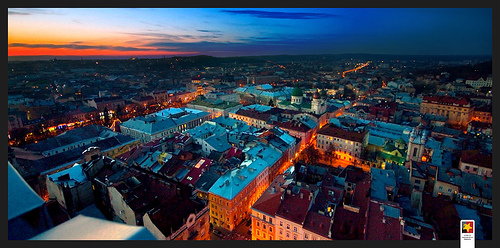
Lviv. Photo by Lyncis

However, we face the real prospect that the 2012 parliamentary elections may mean very little. Even if they are free and fair, including access of all political groupings to the media, the acquisition of ‘tushki’ might allow the powers that be to ‘tidy up’ any slightly messy outcome to the vote. Or who is to say at the moment that these elections won’t go the way of the currently delayed local elections? If this election finishes with the west of the country having no voice, thoughts will inevitably turn to the idea of secession. A strategy for independence would then need some serious thought. If there is a clear sentiment in favour of the idea, unofficial polls might be conducted, perhaps modelled on the unofficial pro-independence referendums that have been taking place across Catalonia.

Independence would have many advantages. Patriotic Western Ukraine would have the over-arching unity of purpose that has benefited the likes of Hungary and Poland. The overseas diaspora would be able to assist in the kinds of ways they were in Estonia, for example. Also, with suggestions that Moldova might just sneak into the EU because ‘it’s small’ (a lame criteria perhaps, but it is how many in Brussels seem to think) perhaps the EU will be able to stomach a bite-size Ukraine of, say, 7-10 million people rather than 46 million, a good chunk of whom it can be argued don’t even want to be there. A small ship is easier to turn. Observe how previously backsliding Slovakia leapfrogged its neighbours to join the Euro.

This may all of course be pie in the sky. Secession is difficult to achieve from any country. However, if aggravations produce policy concessions rather than independence, this may in itself be valuable enough, and would be preferable to marginalisation. Against this however there is the question of the west-looking centre of Ukraine. They might be the next to be marginalised.

Perhaps a separatist approach is not the best way forward at a time when a united opposition is most crucial, but nonetheless Western Ukraine needs to think very carefully before persisting with politicians who talk the talk, but in fact have little interest in the region. There is a grave danger of Western Ukrainians continuing to throw away their votes to minigarchs, thugs and tushki, and it is perhaps time that, as a united front, the region acts for itself. In any case, if the coming years prove to be difficult, a distinction may develop between those who understand and defend their civil and democratic rights, and those who are prepared to allow their freedoms to be compromised for the ‘greater good’.

Of course, the best scenario is not independence for Western Ukraine but for the entire country to be anchored into the EU accession process which helps to foster civil rights, democracy and economic reform for the country as a whole, and which would put pay to many of the worries that currently exist. It is only in the complete absence of a membership perspective for Ukraine that worries about where Ukraine is drifting have become all too real, and hence the need to possibly take a look at some radical alternative scenarios. The alternative of wait and see could be very costly.

To take the analogy of Belgium, another European country that is frequently described as divided, a few decades ago the French-speaking south dominated industrially and culturally, whilst the Dutch-speaking north was poorer. A few years on it is now the north that is in the ascendency with its new industries, with the once proud south a decaying rustbelt. Steel and coalmining are yesterday’s industries, light manufacturing, services and tourism are tomorrow’s, and it is Western Ukraine that is best placed to grasp this opportunity, if it is allowed to.

This has previously been published at Chicken in Kiev (or) Kiev Rus

Civic Campaign: Make Ukraine better!

Ukraine is now living a very particular situation. End of one historical circle (period of European dream born with Orange Revolution) and beginning of some entirely new and perhaps shadow time, marked by political decision of a new government to abandonee European and Euro Atlantic choice for Ukraine.

In that situation, Ukrainian young generation feel that they must do something (anything at all), to make his own position about situation living by contemporary Ukraine.

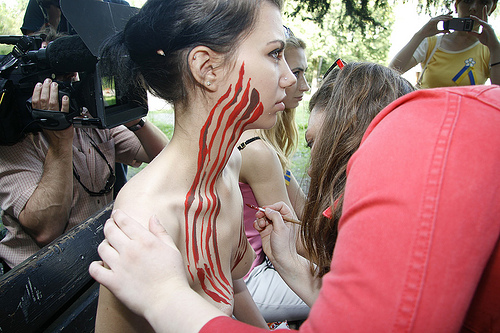
In this actual environment, every political, social or cultural organization or part of civic society uses its own “weapons” of choice. Ukrainian feminist organization FEMEN, received the recent visit of Medvedev with his own performance called “Scratched by bear”.


Photo by FEMEN at Flickr


Other group of youngsters from Kyiv, start at May 11, 2010, a civic campaign “Make Ukraine better!”, intended to unite young generation of Ukrainians around of Ukrainian national idea, in way to remind all those who gave their lives for the country.

The bilingual manifesto of campaign (in Ukrainian and Russian) said:

In remembrance of those who fought for Ukraine and to together future – our initiative:

Belt for Belt (from famous UPA lyrics Lenta Za Lentoyu”):

We have different political views. We speak different languages. But Ukraine is unique for us. Do not be afraid to say that. Do not be ashamed. Do not forget.

Put the flag on your apartment. Add the ribbon to your clothes – to the day-to-day one and to festive one and to any one.

You want to make life better in Ukraine? Do it. Anything. And think about more.

Do you want to do more than just putting the ribbon to your clothes? You’re not alone : )

There are all sorts of issues needing to resolution, and actions that can and should be done. For example, today’s issues to be solved by civil society:

1) demand for joint vision of history – as the basis for understanding in the society;
2) actions for organization of civil society;
3) action against state corruption and the filth of personal responsibility of state representatives and politicians (yes, they also must live with respect for the law and must behave decently);
3) support to culture (not for kitsch);
4) support poor and disadvantaged parcels of society;
5) etc, etc, etc …

You can propose your own actions; you also can support actions of others. For more information, visit the online community Make Ukraine better! There discussions are made, there activities are organized. Why not?

You also can help to our action as follows:

1) Place one of the proposed banners on your blog / site: lentaua.org.ua
2) Send to us your beautiful photos with the ribbons, organize a section of photographs, involve famous people, finally, our action allows your personal PR : )
3) Create the design of the original ribbons, banners or other promotional materials.
4) To popularize and disseminate our initiative in the press, in the Internet, in blogosphere, etc …
5) Share with us your ideas. Write to us, don’t be ashamed in@lentaua.org.ua or join the community http://community.livejournal.com/lenta_ua or visit the campaign website lentaua.org.ua

Information about this initiative in Portuguese:
ucrania-mozambique.blogspot.com

Robbialac Stalinism stopped!

I received the information from the campaign Stop Robbialac today, that the company Robbialac has withdrawn their colour “Vermelho Estaline” (Red Stalin) from their catalog. viewpoint-east.org has previously published Stop Robbialac’s protest letter. Here is what they say.

Robbialac would like to clarify that it was never our intention to offend the victims of Stalinism.

Therefore, in order to avoid any doubts about the issue, Robbialac decided to withdraw suppress the color designation “vermelho-Estaline” and “vermelho Rússia”, from the colour cards where they were mentioned.
Robbialac operates in the Portuguese market for 79 years, and has always maintained a thorough respect for the consumers and employees.

TINTAS ROBBIALAC, S.A.
++++++++++++

Stop Robbialac Stalinism now!

This is an open letter from the blog Stop Robbialac.

Recently, a Portuguese painting company, Robbialac, has created a brand new color, with a name of “Vermelho Estaline” (Red Stalin). Decision of its own management and creative department can be verified in company’s Web products catalog (page number 8, right side, down of the page).

Personally, I have consider this decision as a cynic and sinister way to obtain commercial gains based on inhumane suffering, blood and tears of millions de citizens of Central and East Europe, Central Asia and Caucasus.

Also, I have deeply doubt, that Robbialac managements hasn’t no information about horrors of Ukrainian Holodomor, massacre of Polish officers and civilians in Katyn or about system of Soviet concentration camps, generically known as a GULAG.

Based in all this data, I assume me personal responsibility and duty to not buying any Robbialac products, till a company will take of the market this genocidal paint and will publically ask for forgiveness, to millions of victims of Stalinist tyranny in Europe or in any place in the World.

If you are agreeing with my position, please, contact Robbialac painting to show to the company your own civic position:
robbialac@robbialac.pt
Telephone in Portugal: + 351 21 994 77 00
Fax in Portugal: +351 21 994 77 94
Green Line in Portugal: +351 800 200 725.

Permanent address of this news
http://stoprobbialac.blogspot.com/2010/04/stop-robbialac-stalinism.html

Best regards,

Jest Nas Wielu,
Citizen & Blogger,
Maputo, Mozambique

Blog

About this civic campaign on CNN

My Quest To the City Council: Beginning

‘Curiouser and curiouser!’

I love quests. Otherwise I would have never become a politician. At the same time I never play computer quests, because I am very positive they are quite dull if compared with real political life in contemporary Belarus. Can you get a puzzle to solve just at the very beginning, when you are just registering for the game? Unlikely. In most cases, for introduction you get a long text of the License of Agreement, written in regular Legalese.

Unlike in computer gaming, my quest for becoming a People’s Representative in the City Council started with a whole range of puzzling tasks even before I could get the official registration. When I was registering for candidacy, I was solemnly given a letter from the Tax Inspection office. Why at that very moment? Why only me? Why not via regular mail, but via personal delivery of the Election Commission Chair? The most plausible answer coming to my mind is that the authorities are trying to put pressure on me and the Election Commission members. However, a quest is a quest, so I also sent an official request to the Tax Inspection office and asked them the same questions. They are still keeping silent about their own official motives though. Evidently they are not so experienced in questing…

Just like Alice in Wonderland, I can only say that subsequent events are getting ‘curiouser and curiouser’. Now, Vitebsk region has the one and only independent newspaper, that of VITEBSKI KURIER (Vitebsk Courier), and the newspaper has never been in favour with the authorities. Actually, we will probably soon have to re-brand it as ‘Vitebsk Phoenix’, because the newspaper team now has a lot of skills in ‘rising from the ashes’ (is there a skill like this in WORLD OF WARCRAFT?). So the authorities never liked the newspaper, but with my registration as a candidate the repressions just rocketed up. The newspaper team has violated no law, from the Election Code or any other, but now it is being considered ‘enemy #1’, and the number of enforcers from the local police who are hunting it down can definitely make a bystander think that the police are dealing with nothing less like Professor Moriarty, Vitebsk City level. Why so? Again, the most plausible answer is that in the official scenario for the coming elections there is no place for independent sources of information. But what can be explanations from the police and the authorities? Anyway, VITEBSKI KURIER will be published and will be delivered to the readers no matter what. Just like before, we will outplay the authorities in this quest as well.

‘When I use a word,’ 
Humpty Dumpty said in rather a scornful tone, 
‘it means just what I choose it to mean—
neither more nor less.’

Last week the cars my relatives own turned out to be included in the Road Police list of vehicles reported stolen. How come? Another puzzle to solve. Apparently, when enforcers from Vitebsk police see a car, it becomes just what they choose it to become. Humpty Dumpty did the same with words, but never with private property. The culmination of this logic was the case when on April 7 the car officially owned by my husband was arrested and delivered to a Police precinct on the suspicion that it had been stolen. The fact that I myself was sitting in the car and the owner was personally driving it definitely was not enough to clear the suspicion. The sad thing is that while a police platoon was hunting down, arresting, and escorting my husband’s car, some real criminals could be stealing cars at will.

This new type of logic invented by Vitebsk police is sometimes incomprehensible even for their colleagues. When Mogilev Region police officers found a car from the official list of vehicles reported stolen, they also had their piece of quest. They could not figure out why there were 10 000 copies of an officially registered newspaper in there, neatly packed and ready for distribution. They had seen many things in stolen cars, but a complete circulation of a newspaper issue was really something very new. When they called Vitebsk police, Vitebsk enforcers solved their problem immediately. The ‘stolen’ car presented no interest for them, they just asked to confiscate the newspaper copies. Have you already guessed that the newspaper title was VITEBSKI KURIER? If yes, you are also beginning to collect points in this quest.

By the way, the issue reached the readers anyway. The newspaper team fulfilled the civil duty, is spite of the hindrances developed by the authorities and their enforcers. We never forget about our main quest and its mission: to provide people with free unbiased information.

‘Now, I give you fair warning,’ 
shouted the Red Queen, stamping on the ground as she spoke; 
‘either you or your head must be off, 
and that in about half no time! 
Take your choice!’

Arranging a meeting with my voters was a whole new part of my quest, and there I had to use a lot of my ‘skills and points’. On April 10 my representative sent an official letter to the Administration of Oktiabrski District of Vitebsk notifying them that on April 12-14 I was going to hold meetings with my voters on the territories near their apartment houses. Knowing how ‘creative’ the Red Queen can be in putting obstacles for people who want fair representation, we also sent another copy by registered mail. The royal reaction was fast and furious. The official reply #01-19/19В signed by Mr. V. A. Galanov, the first deputy of the Administration Head, read that ‘… based on the information above, you are not allowed to hold meetings with information and entertainment elements on the territories near the apartment houses of Klinicheski Election District #51… the only place you can use is the open-air scene located at 63-1 Pravdy Street.’

In my election precinct there are a lot of places fully suitable for an open talk with voters. Why didn’t the authorities mention them? Another puzzle… Anyway, I am a law-abiding citizen, so I answered that if it is ‘the open-air scene located at 63-1 Pravdy Street’, let it be so. Let us play there, and let us play fair.

My election precinct is special, because there are four candidates. In most precincts throughout Belarus there is just one. To make the election quest simpler? Well, I and my activists are sure that ‘no selection—no election’. The citizens’ choice must be educated, people must know their candidates, their backgrounds, their programs. The candidates must meet in fair verbal battles, so that people will see who is who now and who is going to be who after the elections. That is why on April 14 I personally called all my rivals and invited them to come to the meeting in the evening to the one and only ‘open-air scene located at 63-1 Pravdy Street’. All the other candidates confirmed receiving the information, and none of them said that they were organizing their own events at the time.

However, the Red Queen had her own views on how candidates must compete for votes. At about 6pm, just one hour before my arranged meeting with voters, I got a call to my mobile phone. A male introduced himself as ‘A. K. Kondratovich, a deputy head of Oktiabrski District Administration’, and then immediately revealed his true nature of being just a playing card in the authority pack. He said that they banned my meeting with voters because another candidate earlier applied for the same place and time, and the candidate does not want my presence there. I felt just like Alice again—I had to be off, and that in about half no time. Needless to say that the candidate was one of those whom I was calling at noon, and he said not a single word about his own ‘planned’ meeting. Had the Red Queen turned him into a zombie? Or was he a zombie from the very beginning?
Continue reading ‘My Quest To the City Council: Beginning’

Ukraine write Freedom of Information Act with help of German experience

In today’s issue of Deutsche Welle Olha Wesnjanka writes an interesting article about the situation for freedom of information in Ukraine. Ukraine has a freedom of information legislation from 1996, but it does not include a specification on general right of access to information. The law therefor needs to be improved.

The head of Center for Political and Legal Reforms in Kyiv, Mariana Demkova, implies that to introduce a Freedom of Information Act in Ukraine will take a considerable long time, and this is due to that fact that processes like this are complex. Demkova refers to how the situation was when Germany implemented the Freedom of Information Act. Germany experience number of complex problems that Ukraine can learn from. “For Ukraine it is certainly important and useful to investigate the German experience: what stood in the way of difficulties in developing, how did it go to implement bill and to enforce the law in practice”, Demkova says to Olha Wesnjaka.


Will Ukrainians be able to get more information about
their rulers online in the future?
Photo: Sophie Engström

A group of Ukrainian specialists, headed by deputy Andriy Shevchenko, will therefor go to Germany to meet German collegues and ministers to discuss and learn about the implementation the federal law on freedom of information in Germany. Since the Ukrainian Federal commissioner for data protection and freedom of information will visit the Ministry of Economy, which takes care of telecommunications issues, the Ukrainian Pirate Party should feel some concern. ACTA traditionally works very close to ministries in Europe that handle questions like freedom of information.

Bandera is still not an easy task to solve

I was asked a while ago to publish an open letter to the Portuguese MP’s of European Parliament signed by President of the Association of Ukrainians in Portugal, Pavlo Sadokha, 
President of the Association of Ukrainians in Portugal “Sobor”, Oleg Hutsko and the 
President of the Association of Ukrainians Algarve, Natalia Dmytruk. The open letter is a criticism against that the European Parliament adopted a resolution on 25 of February of 2010, starting “[d]eeply regrets the decision of the outgoing Ukrainian President, Viktor Yushchenko, is granted posthumously to Stepan Bandera, leader of the Organization of Ukrainian Nationalists (OUN)[...]“.

It is not an easy task to write an objective analyze how European Union, Ukraine, Russia should deal with the historical legacy of Stepan Bandera. I therefore hesitaed in doing so, and instead I refer to an article at Kyiv Post, published on the 13 of April 2010.

The open letter below was previously published at ucrania-mozambique.blogspot.com

ASSOCIAÇÃO DOS UCRÂNIANOS EM PORTUGAL
Rua Félix Correia Nº1, 2-Esq., 1500-271 Lisboa
tlm.: 967135885 / 964795123 NIB 506 695 107
e-mail: ucranianosemportugal@gmail.com

17/03/2010

Open Letter to the Portuguese MP’s of European Parliament
Dear. Mr. / Mrs., MPs,

It is now widely accepted that the European project has contributed decisively to the economic and social stability of the continent and to promote freedom and equality of citizens in Europe. Its democratically elected representatives consider the main objective of the European Union to ensure the welfare and protection of citizens rights, and for that, and based on the lessons of history, rejected any form of discrimination (racial, ethnic, religious, etc.). However, this does not mean the denial of historical and cultural heritage of the peoples of Europe, oppositely, the preservation of national cultures and languages, and respect for the historical past are some of the essential prerequisites for EU membership.

Speaking of historical past should be remembered that Ukraine never has any expansionist ambitions, and, oppositely, was the battleground of rival imperialist powers, with the consequent loss of sovereignty and national identity. During the World War II following the Nazi and Soviet aggression, Ukraine lost about 7.5 million inhabitants and approximately 2 million of Ukrainians were deported to labor-slave activities to Germany.

On the other hand, Ukraine, was also the scene of totalitarian tragedies, one example being the Great Famine of 1932-1933 (Holodomor) – qualified recently by the European Parliament of “horrendous crime against the Ukrainian people and against humanity” – that killed about 7 millions of Ukrainians as a result of famine caused by the Stalin dictatorship. At that time, the Organization of Ukrainian Nationalists (OUN), headed by Stepan Bandera, was forced to use the only language understood by a totalitarian regime and that could receive the attention of the international community: language of strength. On 22 of October of 1933, the Soviet consul in Lviv was killed by a militant of OUN in retaliation for the millions of Ukrainians decimated in the famine genocide.

This fact regain an greater meaning if we remember that other dramatic moments of the twentieth century, there was a need to commit a similar acts. For example, between 1920–1922, the militants of Armenian Revolutionary Federation killed several leaders of Turkey, in response to the Armenian genocide; on 27 of May of 1942, agents of the Czechoslovak secret service murdered the British Nazi leader Reinhard Heydrich, responsible for terror in Bohemia – Moravia and one of the key masterminds of the genocide of the Jewish population. 

Still on past history, the European Parliament adopted on 25 of February of 2010, a resolution on the current situation in Ukraine, stating that:
20. Deeply regrets the decision of the outgoing Ukrainian President, Viktor Yushchenko, is granted posthumously to Stepan Bandera, leader of the Organization of Ukrainian Nationalists (OUN), which collaborated with Nazi Germany, the title of “National Hero of Ukraine” and expects that new Ukrainian leadership to reconsider this type of decision and reaffirm its commitment to European values.

In this resolution, Parliament claims his right to indicate to Ukrainians how they should interpret their own history. Moreover, what is the basis of what decision? Is there any sentence issued by an International Tribunal to sentences Stepan Bandera or Ukrainian Insurgent Army (UPA) for collaboration with Nazi Germany? Have been carried out a thorough historical investigation of the Ukrainian independence movement?
It is important to realize that Stepan Bandera symbolizes in an undeniable and tragic way, a struggle for Ukrainian independence, finally achieved in 1991, was an inspiring idea to generations of freedom fighters and, simultaneously, the target of hatred of those who have imperialist designs for Ukraine.

On 30 of June of 1941, following the German invasion of the Soviet Union, OUN proclaimed the restoration of independence of Ukraine. This act represented a clear challenge to racial and expansionist plans of Hitler, which, in turn, wanted to convert Eastern Europe into a huge Germanic empire. Therefore, the German authorities demanded that the leaders of OUN abdicate its purpose, and at the refusal, unleashed a campaign of violent repression, forcing the independence movement to go underground and fight against the two occupying powers in Ukraine: the Soviets and the Nazis.

In July of 1941, Stepan Bandera was arrested and sent to the concentration camp of Sachsenhausen, where he remained until October 1944. Two of his brothers were deported to the extermination camp of Auschwitz, where they was brutally murdered. In the ravine of Babi Yar in Kyiv, alongside with thousands of Jews, were also murdered hundreds of militants of the OUN. Stepan Bandera himself also met a tragic end, when he was murdered in 1959 in Munich, victim of a secret agent of KGB.

At the Nuremberg Trials of 1945 was revealed a secret document of Einsatzkommando C / 5, dated of November 25, 1941, which invalidates any argument about the alleged complicity of Bandera and OUN with the Nazis:
There is evidence that the movement of Bandera prepares a revolt in Reichskommissariat, whose aim is to create an independent Ukraine. All members of the movement of Bandera should be immediately arrested and, after a thorough interrogation, secretly wiped out like bandits. 

In fact, what occurred was a brave and determined resistance of the independence movement against the violence used by totalitarian powers who wanted to order the Ukrainian nation to the slavery and extermination.
We, Ukrainians who came to Portugal in search of work and a better life, we have been committed to contributing to the progress and welfare of the host country. Many of us have chosen Portugal as their second home, receiving, therefore increasing visibility and relevance to our civic integration.

Therefore, in the dual capacity of Ukrainian and Portuguese fellow citizens, is urgent to repeal section 20 of the European Parliament resolution of 25 of February of 2010, in which the National Hero of Ukraine is unreasonably accused of cooperating with the Nazi tyranny. It is a moral imperative to recognize Stepan Bandera not only as a figure in the history of Ukraine, but also the universal fight for freedom and human dignity.

Yours sincerely,
President of the Association of Ukrainians in Portugal – Pavlo Sadokha 
President of the Association of Ukrainians in Portugal “Sobor” – Oleg Hutsko 
President of the Association of Ukrainians Algarve – Natalia Dmytruk

____
Attachments:
1.
20. Deeply deplores the decision by the outgoing President of Ukraine, Viktor Yushchenko, posthumously to award Stepan Bandera, a leader of the Organisation of Ukrainian Nationalists (OUN) which collaborated with Nazi Germany, the title of ‘National Hero of Ukraine’; hopes, in this regard, that the new Ukrainian leadership will reconsider such decisions and will maintain its commitment to European values;

2.
Open Appeal from Ukrainians to the Members of European Parliament with regards to the defamation of Stepan Bandera in the text of the Resolution of the European Parliament on the Situation in Ukraine from February 25, 2010.

A Missing Gaze

Melody for a Street Organ (2009) by Kira Muratova compensates for the 20 years-long absence of social cinema in Ukraine in a strikingly unexpected way. To capture the social reality of Ukrainian society is not an easy task, since, like any other post-Soviet society, it avoids a direct look at its basic manifestations (like marginalization of large social segments and dissolution of interpersonal links) by rendering them invisible for the mass media apparatuses. In order to assemble the mosaic of unrepresented society, Muratova has chosen the vantage point that is generally repressed in contemporary Ukraine. Her latest film is set in public spaces where taking pictures is usually prohibited for reasons that are neither explained nor questioned, in spite of availability of those spaces for the general public: the train station and the supermarket.

The first part of the film follows a couple of homeless kids through a railway station, where they are confronted with a series of unfavourable circumstances, while the second part takes them to a supermarket, where the penniless protagonists, hallucinating from hunger, are trying to get some food. Still, those areas – the railway station and the supermarket – are only seemingly excluded from democratic representation, since they are subjected to numerous surveillance apparatuses that not only passively collect information but also actively constitute the social relations at the observed territory, producing the subjectivities of those under surveillance. By entering this domain of monopolized representation with her camera, Muratova gets an opportunity to spy at the members of contemporary society reduced to their purely functional, mechanical identities – those of the train passengers or supermarket clients.

This reduction is obvious in numerous film scenes where the kids appeal to occasional strangers with a cry for help only to get a standardized, artificial, ‘cinematic’ reaction from the people who cannot transcend their prescribed social roles. In a crucial episode of the film, the kids occasionally witness the extrinsic child beggar telling their own numerously repeated story verbatim to a stranger and getting a generous reward. The shock that children experience in the course of the scene is quite similar to a shock of the viewer confronted with Muratova’s numerous episodic characters that despite of their constructed, unnatural behaviour (or, maybe, precisely owing to these features) are strikingly recognizable in their representation of post-Soviet social identities. Rather than reproduce “reality as it is”, Muratova focuses on fiction underlying the reality itself, a fiction that is deconstructed from an ‘impossible’ viewpoint of the camera sneaking after the people who unconsciously perform their prescribed identities.

Oleksiy Radynski is an essayist, editor and scholar of film theory. He is a postgraduate student at the National University of Kyiv-Mohyla Academy and collaborator at Visual Culture Research Center at the same university.

Related Posts with Thumbnails